
The QWERTY Conundrum
From Dvorak to Vojak

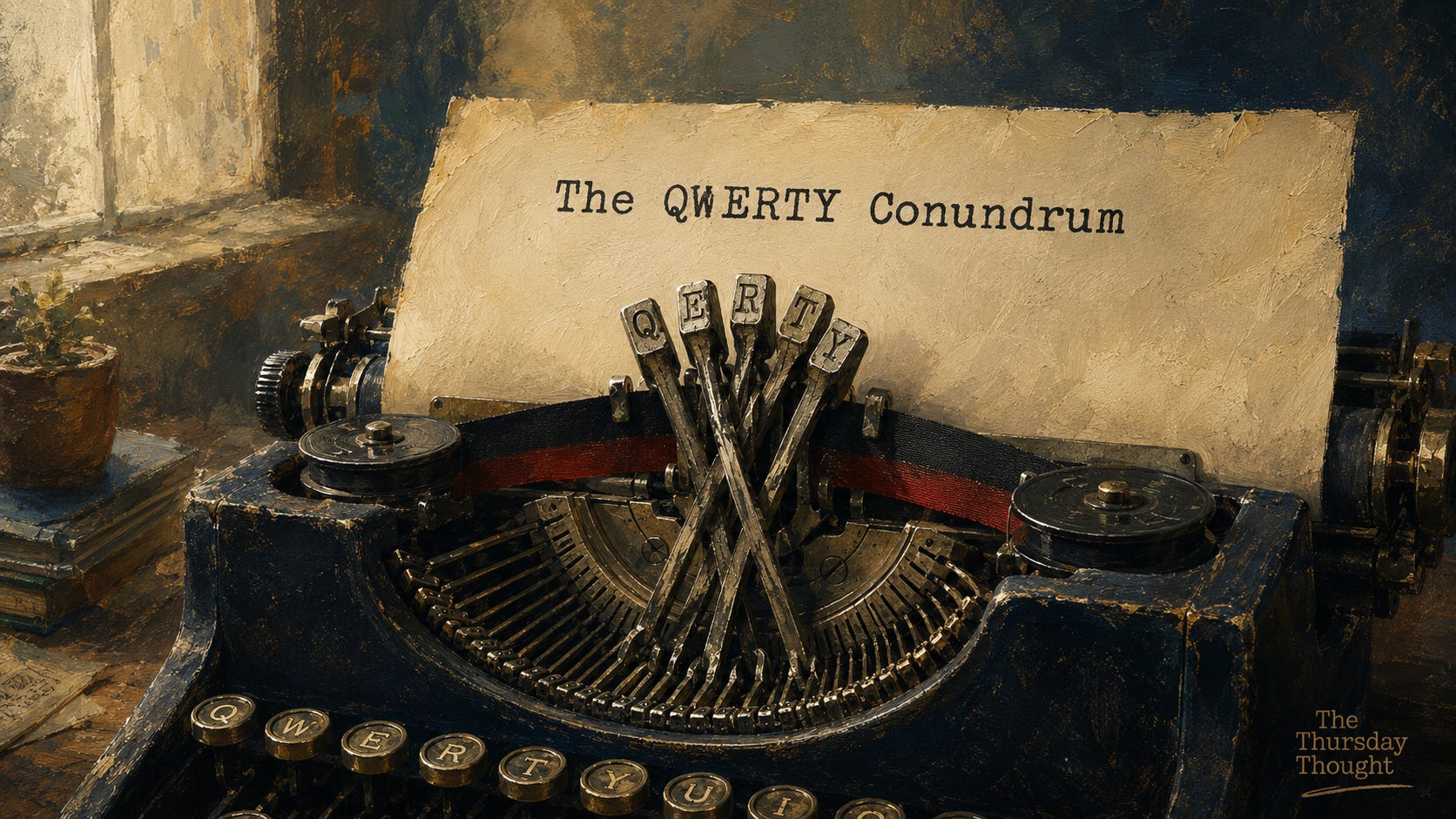
“The righter we do the wrong thing, the wronger we become." - Russ Ackoff
TL;DR: QWERTY was an engineered solution to a problem that disappeared a hundred years ago. The mechanical typebars that could jam in 1870s typewriters are gone. The layout they forced on us survived three paradigm shifts and now lives on the glass screen in our pockets, where there is nothing left to jam. Organisations behave the same way. They build themselves with extraordinary precision around a winning formula, become beautifully aligned to that formula, and then cannot unwind even when the world has moved on. The very alignment that produced the initial advantage becomes the thing that prevents the next one.
When I was a child, my parents had a typewriter, and I loved jamming the keys. I would press lots of letters at once and watch the metal arms collide and tangle, then untangle them and do it again. Years later, I realised the solution to that physical jam had become its own kind of mental jam for anyone who had ever learned to type. The more expert the typist, the more jammed they became.
Anti-engineered

In 1873, Christopher Sholes finalised the layout of the keyboard that bears the name of its first six letters. Sholes did not design QWERTY for the typist. He designed it for the metal arms of the typewriter, which jammed when neighbours fired in sequence. Sholes rearranged the letters so that the most commonly used pairs sat far enough apart that the arms would not collide. Everett Rogers, in Diffusion of Innovations, calls what Sholes did “anti-engineering.” He intentionally slowed typists down to keep the machine from breaking.
Salesmen reinforced it by pecking out the word TYPEWRITER on the top row, all the letters conveniently in place, and a sales pitch for an inefficient design became the design’s reason for spreading. By the time touch typing became popular and the original mechanical jam was no longer a problem, an entire ecosystem had organised itself around the layout. Manufacturers built for it, schools taught it and typists trained on it. The constraint was gone, but the arrangement remained.
In 1932, Professor August Dvorak at the University of Washington decided to do something about it. He spent a decade filming and studying typists, and carefully designed an alternative layout that was significantly faster and easier on the hands. The QWERTY keyboard keeps only 32% of typing on the home row. The Dvorak layout pushes that to roughly 70%. Dvorak typists had broken all speed records. The change was a no brainer, and the American National Standards Institute eventually approved Dvorak as an alternate. So what happened? Almost no one switched!
The mechanical problem that produced QWERTY had disappeared with the electric typewriter. Then the typebar disappeared with the computer. Today, the physical key has disappeared with the phone. But that layout came along for the ride into each new paradigm, including a paradigm in which there is nothing on the underlying mechanism that can jam at all.
As you can guess, this is not really a tale of keyboards.
Wrong Jungle

“The alignment that makes a mature organisation successful can kill an emerging business. And in the same way, the alignment that makes an emerging business work can make a mature business inefficient.” — Charles O’Reilly and Michael Tushman, Lead and Disrupt
Michael Tushman and Charles O’Reilly studied why successful companies struggle to navigate change. They found that successful firms tend to organise themselves with extraordinary precision around whatever is currently working. Strategy, structure, people, formal systems, and culture all line up behind the same opportunity. They call this congruence, and they argue that congruence is what produces success in the first place. An organisation pulling in one direction is more powerful than one pulling in five.
The trap is that the congruence does not untangle when the environment changes. The very alignment that produced the win becomes the thing that prevents the next one. This is the supreme irony of organisational success. The success syndrome is what happens when the original alignment calcifies. By the time the world has moved, the original bet has become the building.
Stephen Covey tells a version of this in story form, in his classic The 7 Habits of Highly Effective People. A group of producers cuts through the jungle with machetes, clearing the undergrowth. The managers behind them sharpen blades, write policy manuals, set up working schedules and compensation programs for the machete wielders. The leader is the one who climbs the tallest tree, surveys the entire situation, and yells, “Wrong jungle!” The busy, efficient producers and managers respond: “Shut up! We’re making progress.”
The thing worth understanding about the people refusing to look up from the undergrowth is that they are not stupid. They are experts at doing what made them successful. They are the best machete wielders in the company, the ones who know every angle of attack, every shortcut through the brush, every nuance of the work. It is their expertise that gets in their way. The people most committed to the current path are the people who understand it most deeply, who have spent their careers building the skills that make it work, and whose judgement is most trusted precisely because of that experience.
This is what the tree climber and the producers look like in the corporate jungle.
The Brick

“The greatest danger in times of turbulence is not the turbulence; it is to act with yesterday’s logic.” - Peter Drucker
Tom Osborn was the tree climber in a chemist’s clothing at Procter and Gamble in the early 1980s. He was working in the feminine care category. P&G had recently launched its first Always pad. The launch was a market success. The product was thicker than competitive pads, with a proprietary topsheet, designed to outperform on leakage protection. Everyone in P&G was lined up behind it.
Osborn felt they could do better.
A lot of the people in the feminine care category had come over from P&G’s diaper business, and that successful mental model along with them. The product they had built was, in plain truth, a diaper dressed up as a sanitary towel. The diaper team thought of menstrual fluid the way they thought of urine, a thin, free-flowing stream that needed to be captured and contained. It was thick because diapers were thick. It was absorbent because diapers were absorbent. The model worked for diapers, so nobody questioned it for pads.
Osborn was inside that same culture. He had come up through P&G, trained the same way, worked alongside the same people, used the same mental model. When he started examining used pads under a microscope, he was not bringing in foreign expertise. He was looking at his own field with a beginner’s mind.
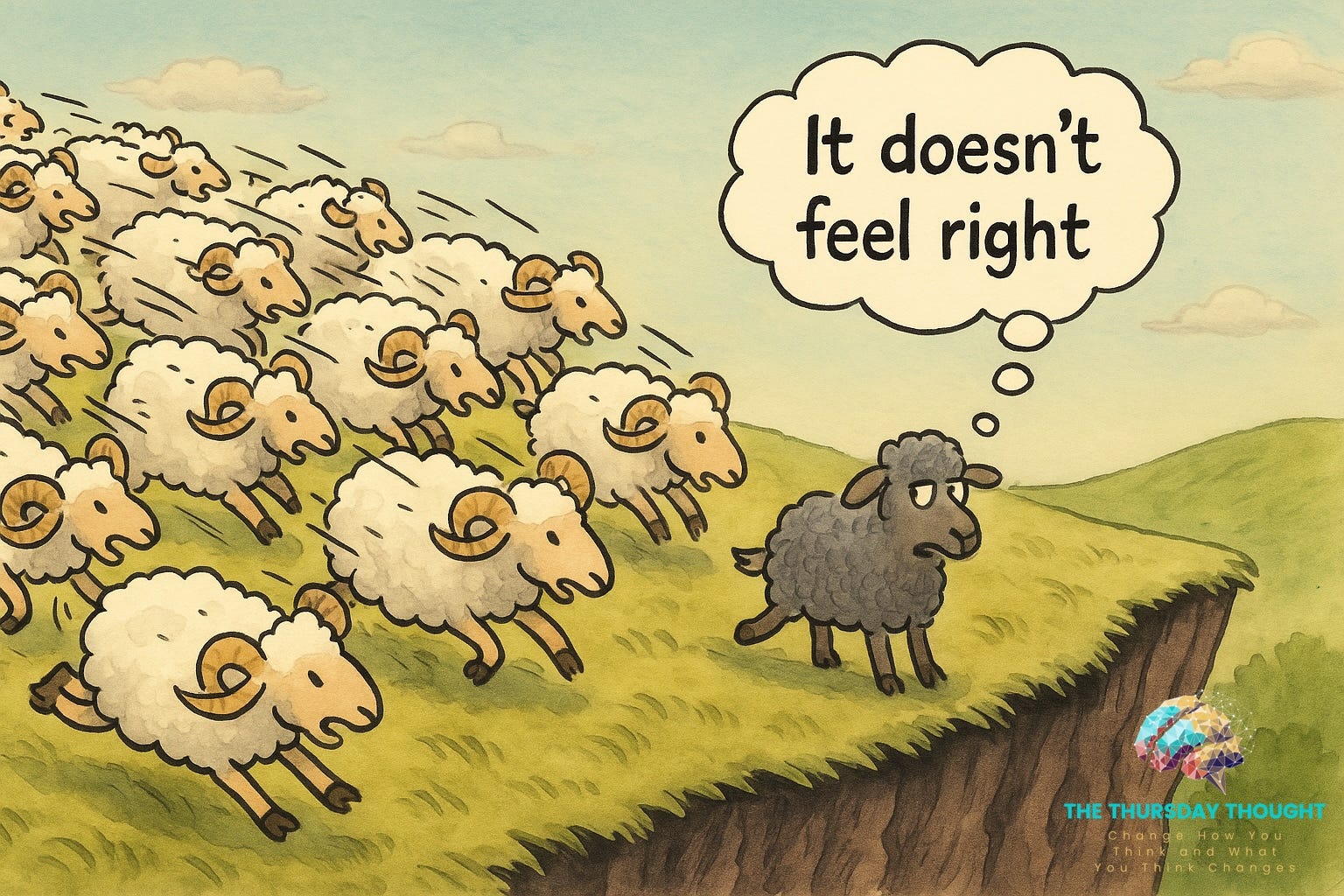
The team had also been through what last week’s Thursday Thought called the co-ownership dynamic. They had struggled, internalised, and emerged loving and preaching the model. That was their strength, but it soon became their wall.
The product the mental model produced was, in Osborn’s own words, an “absorbent brick”, about an inch thick, two-and-a-half inches wide, and six to eight inches long. Women described wearing it as wearing a brick. Nobody inside P&G considered this a problem because the model said the brick worked.

Osborn ran his own research. He examined hundreds of used pads. Through researchers at a nearby medical school, he learned that menstrual fluid was not a thin free-flowing stream at all, but a viscous fluid leaving the body slowly, in drops and intermittent surges. The diaper model was the wrong model. He proposed a fundamentally different design. A pad understood not as an absorbent device but as a garment. Thinner, softer, flexible, contoured to the body. A replaceable panty crotch rather than a brick.
His manager ordered him to stop. When he kept working, his technical support was withdrawn and the termination process began. He was nearly terminated twice across the project. Eventually a new manager, a scientist by training, approved a small panel test. About 80% of the participants preferred Tom’s prototype. Like Dvorak before him, the data was unambiguous. Like Dvorak before him, his product was rejected. Some managers said the panel was too small. Others said his model of menstruation was wrong, so the data must be wrong. Most simply pointed at the current product, which was selling beautifully, and asked what problem he thought he was solving.
Another sympathetic manager later approved a larger head-to-head test against the company’s own upgrade product. Tom’s pad won that one too, on comfort and on cost. Still no movement at headquarters. The breakthrough finally came from outside. The head of R&D at one of P&G’s international locations ran the prototype in his region, where comfort mattered more to the local market, and the results were strong enough to support a launch abroad. A Tom-designed pad shipped overseas first (no one is a prophet in their own land, right). Only then did the home organisation come around. It launched as Always Ultra and became a billion-dollar brand.
The thing worth considering is not the eventual victory. It is what Osborn was up against. He was an insider himself, applying the same training as the people who resisted him, looking at the same data, working in the same building. The difference was that he climbed the tree. The producers, expert at diapers, could not see the diaper inside the brick they had built for someone else. The product proved itself overseas first, and only then could the home organisation see what it was looking at.
From Vojak to Dvorak
“Companies miss the future not because it was unpredictable, but because it was unpalatable.” — Gary Hamel
Bruce Vojak and his collaborators spent years studying the rare people inside large organisations who push breakthrough work all the way through to the customer, repeatedly, despite everything the system does to absorb them. They called them serial innovators. The pattern Vojak describes is the keyboard story written in human terms. A superior alternative exists. Someone inside the organisation can see it. The path is closed anyway. Not because anyone made a bad decision in the moment, but because the cost of switching has become higher than the cost of staying with what is already working.
What the serial innovator is doing, in Vojak’s language, is building “a new coherence” around the better answer, strategic and tactical, person by person, until the new alignment is heavier than the old.
The QWERTY conundrum is not really about whether something better exists. It almost always does. The conundrum is what to do about an organisation, or a market, or a habit of mind, that has organised itself so coherently around an obsolete answer that the better answer cannot get a hearing.
Last week’s Thursday Thought argued that ideas survive on co-ownership. This week’s argues that the same co-ownership becomes the lock-in. The two pieces are the same mechanism viewed from two ends of its life. Co-ownership is how things ship. Co-ownership is also how things calcify. The serial innovator’s task is to know which face of it is in front of them, and to act accordingly.
I do not have a tidy resolution for this. I am not sure there is one. What I notice is that the people who broke through in Vojak’s research did not solve the problem by being right. Being right was the easy part. They solved it by surviving long enough inside the system for the system to change its mind.
As W. Edwards Deming is often credited with saying, "a bad system will beat a good person every time." So does a system that was right for the wrong time.
On this week’s Innovation Show, we speak with Bruce Vojak in part two of our series on his work, Serial Innovators. We discussed navigating the politics of breakthrough innovation, the difference between strategic and tactical coherence, and how serial innovators cross the bridge from inventing to influencing. That episode drops soon.
I also released a short bonus episode where Bruce walks through the Hourglass Model — the descriptive map of how serial innovators actually work, which is where the Tom Osborn story first opened up for me and inspired me to write this article. Paid subscribers will get access to these diagrams with Bruce’s permission.
For more on why companies miss the future, my 16-part series with Gary Hamel is here.
My conversations with Michael Tushman and Charles O’Reilly on Lead and Disrupt are here.
A really excellent distillation on innovation within organizations, and why can it feel so frustrating. In a startup phase, incentives are aligned to experiment, with leadership that has split off because it believes in the promise of a different method. In established organizations, leaders lose that incentive. So the question for me is how you reintroduce and balance that desire to try something new in a mature system.
This is the prime quote in the work: "Being right was the easy part. They solved it by surviving long enough inside the system for the system to change its mind."