
Day 1 or Irrelevance
What Axolotls, Immortal Jellyfish, and Zen Masters Know

“Every child is an artist. The problem is how to remain an artist once he grows up.” — Pablo Picasso
TL;DR: Many companies, like the axolotl, fail to evolve beyond their early success and eventually become obsolete. Jeff Bezos’s concept of Day 1 thinking is a blueprint for avoiding stagnation. But what if your company has already slipped into Day 2? The antidote has been hiding in plain sight, in Zen monasteries, in biology labs, and in a word the dictionary barely knows: childing.
There is a creature in the highland lakes of Mexico City that never grows up.
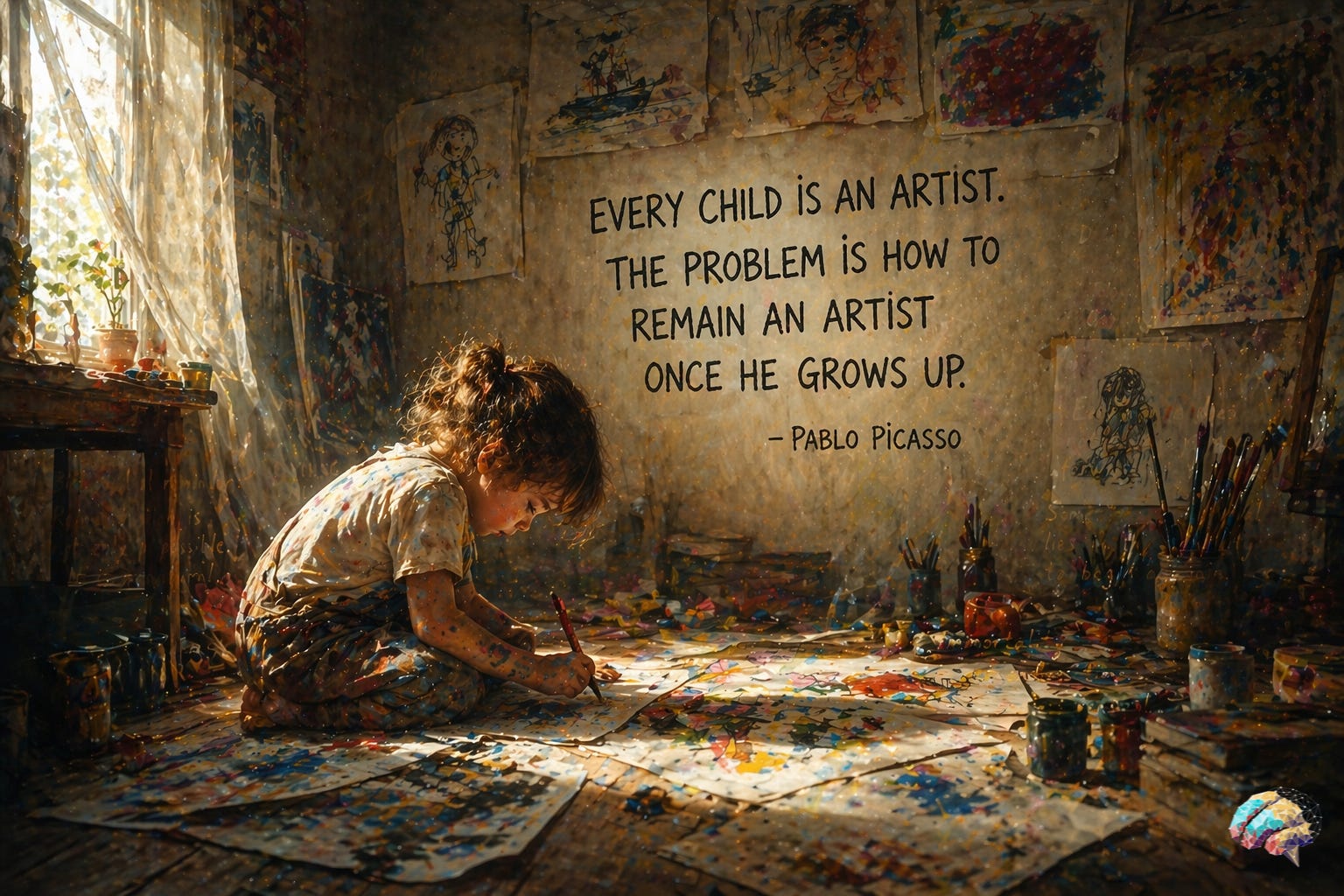
The axolotl (Ambystoma mexicanum) is a fascinating amphibian that retains its juvenile form throughout its entire life. Unlike other salamanders that transition from water-dwelling larvae into air-breathing adults, the axolotl keeps its feathery external gills and lives permanently in water, even as a sexually mature adult. It never undergoes metamorphosis. Because its environment has been so historically stable, evolution never forced it to change. The axolotl’s permanent youthfulness, a phenomenon biologists call neoteny, is an advantage in its niche. But it is also a vulnerability. If its environment changes drastically, the axolotl lacks the adaptability that other amphibians developed precisely because they were forced to evolve.
It is the perfect metaphor for a company that has stopped asking questions.
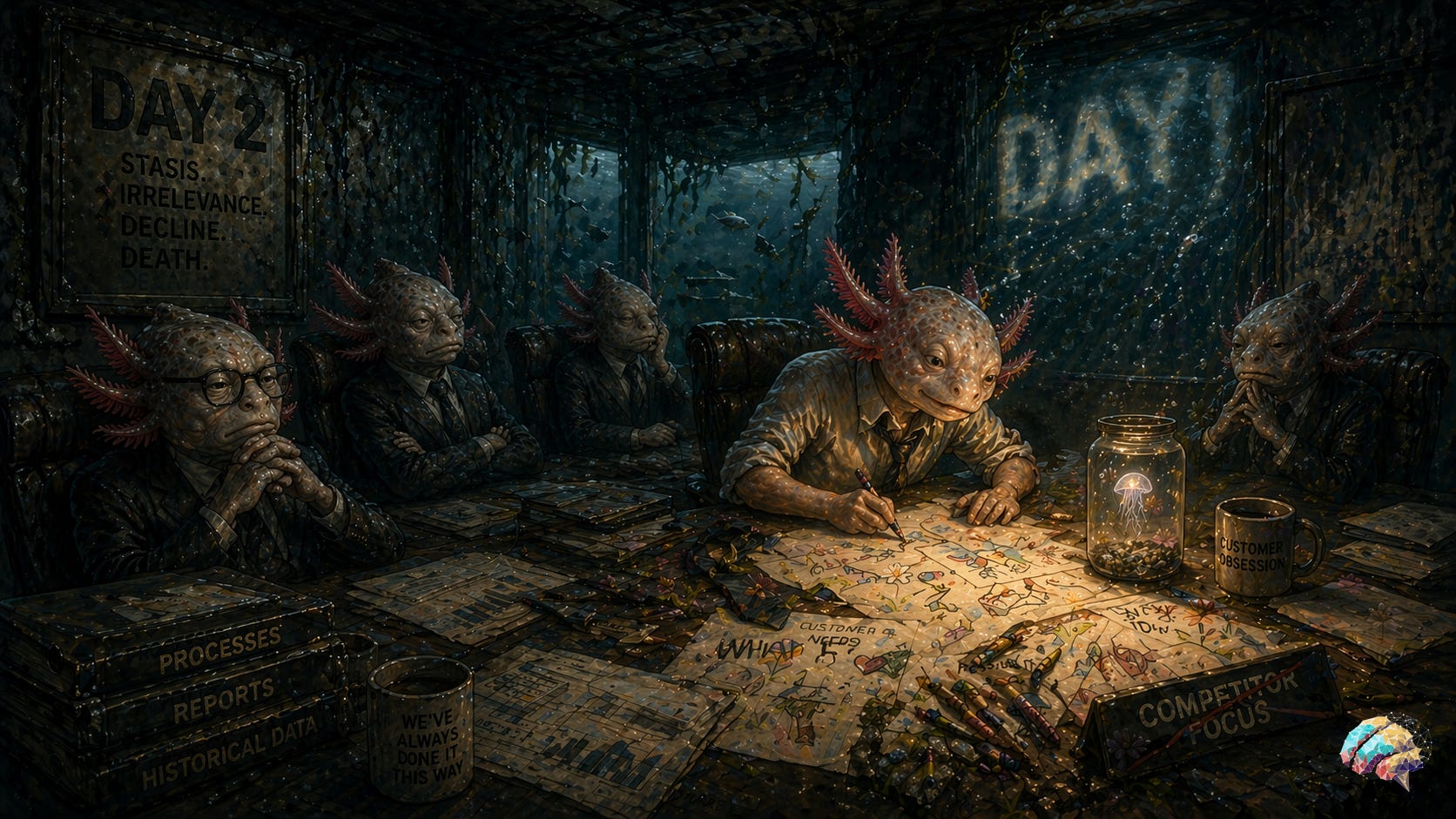
Some companies are axolotls. They find a winning formula early and see no reason to change (or don’t see why they should). For a while, this static strategy works, until the environment shifts. Companies that follow this path become trapped in what Jeff Bezos calls “Day 2” thinking: a dangerous state of stagnation that, while it may feel comfortable for a time, eventually leads to decline.
Always Day 1
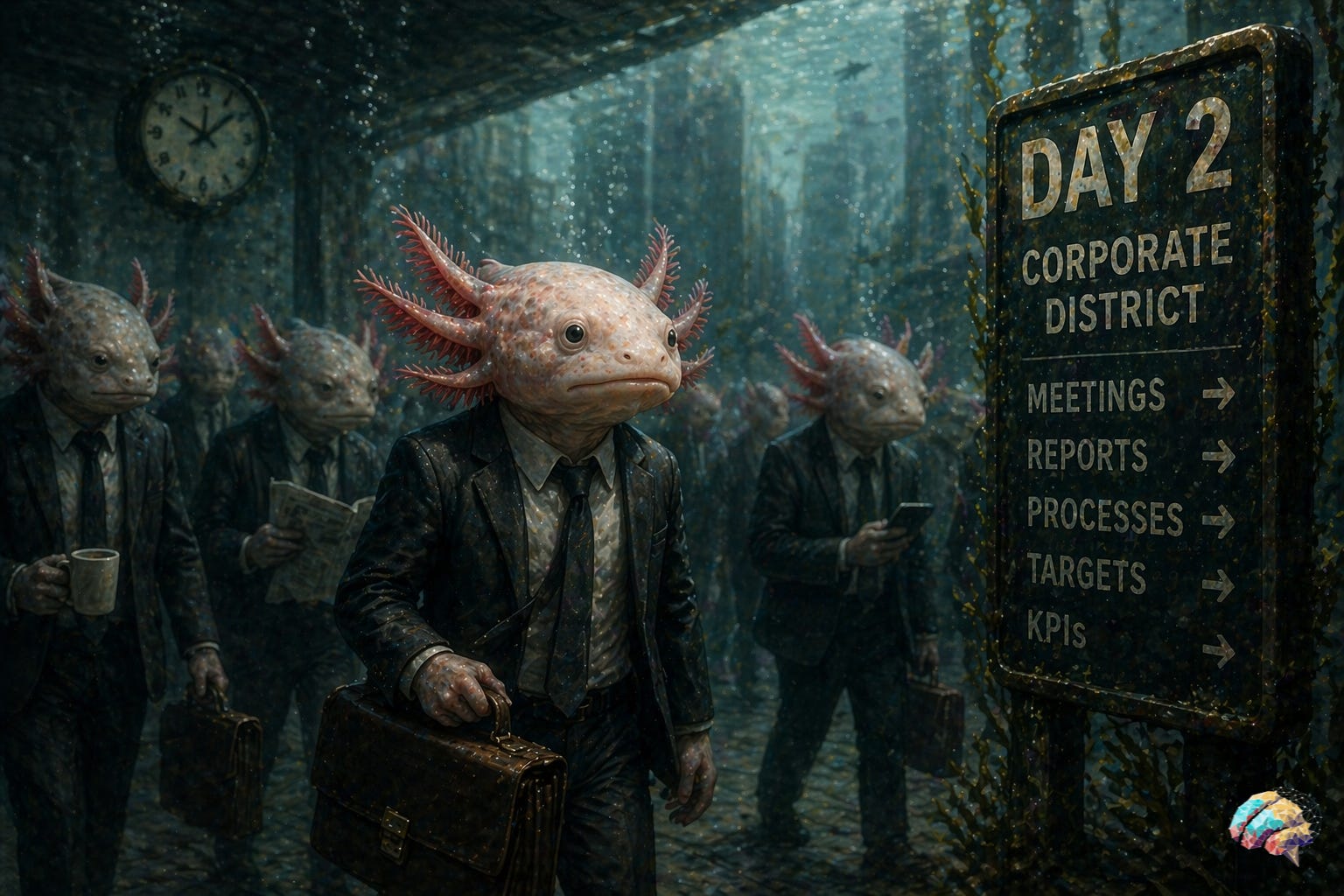
“Day 2 is stasis. Followed by irrelevance. Followed by excruciating, painful decline. Followed by death. And that is why it is always Day 1.” — Jeff Bezos
Jeff Bezos described Amazon’s philosophy of “Day 1” thinking in a 2016 shareholder letter. He named Amazon’s first office building “Day 1,” and when the team moved to a new building, he took the name with him. A constant reminder to never slip into complacency.
He warned that Day 2 decline can happen in slow motion. A company might appear successful for years, even decades, all while it is gradually losing its edge. To outsiders, and even to those inside, everything seems fine until it suddenly is not.
To stay in Day 1, Bezos outlined four essential principles.
Obsess over customers, not competitors. They are, as he put it, “always beautifully, wonderfully dissatisfied,” always wanting something better.
Resist proxies: never let process become more important than outcome.
Embrace external trends before they become obvious, because fighting inevitabilities is fighting the future.
And make decisions at speed. What Bezos called “two-way door” decisions are reversible, so make the call with roughly 70% of the information you want and course-correct fast. As he put it: “Being wrong may be less costly than you think, whereas being slow is going to be expensive for sure.”
But his framework leaves an unanswered question. How do you actually think like it is Day 1? How do you genuinely see with fresh eyes when you have spent decades accumulating expertise? The Zen teacher Shunryu Suzuki understood this long before Bezos did.
The Curse of Expertise
“In the beginner’s mind there are many possibilities. In the expert’s mind there are few.” - Shunryu Suzuki
Shunryu’s words are not merely philosophical, they ring true in the real world. Research into expert guitarists found something remarkable. Those asked to play with their instrument reversed, an awkward and disorienting experience, felt like beginners again. They saw more potential in novice players, and novices found their advice significantly more helpful. Rediscovering the experience of inexperience is a way to counteract what researchers call the misleading and potentially life-threatening feeling of knowing.
The art world understood this too, at great cost. When Édouard Manet and the Impressionists unveiled their work, they were met with scathing rejection from those who were supposed to know best. The experts. Manet’s unconventional approach was dismissed as incompetent by the very people who shaped the field. Ultimately, his movement became one of the most consequential chapters in art history. Expertise, it turns out, can be a superb tool for doing things that have already been done, and a terrible liability for seeing and supporting what comes next.
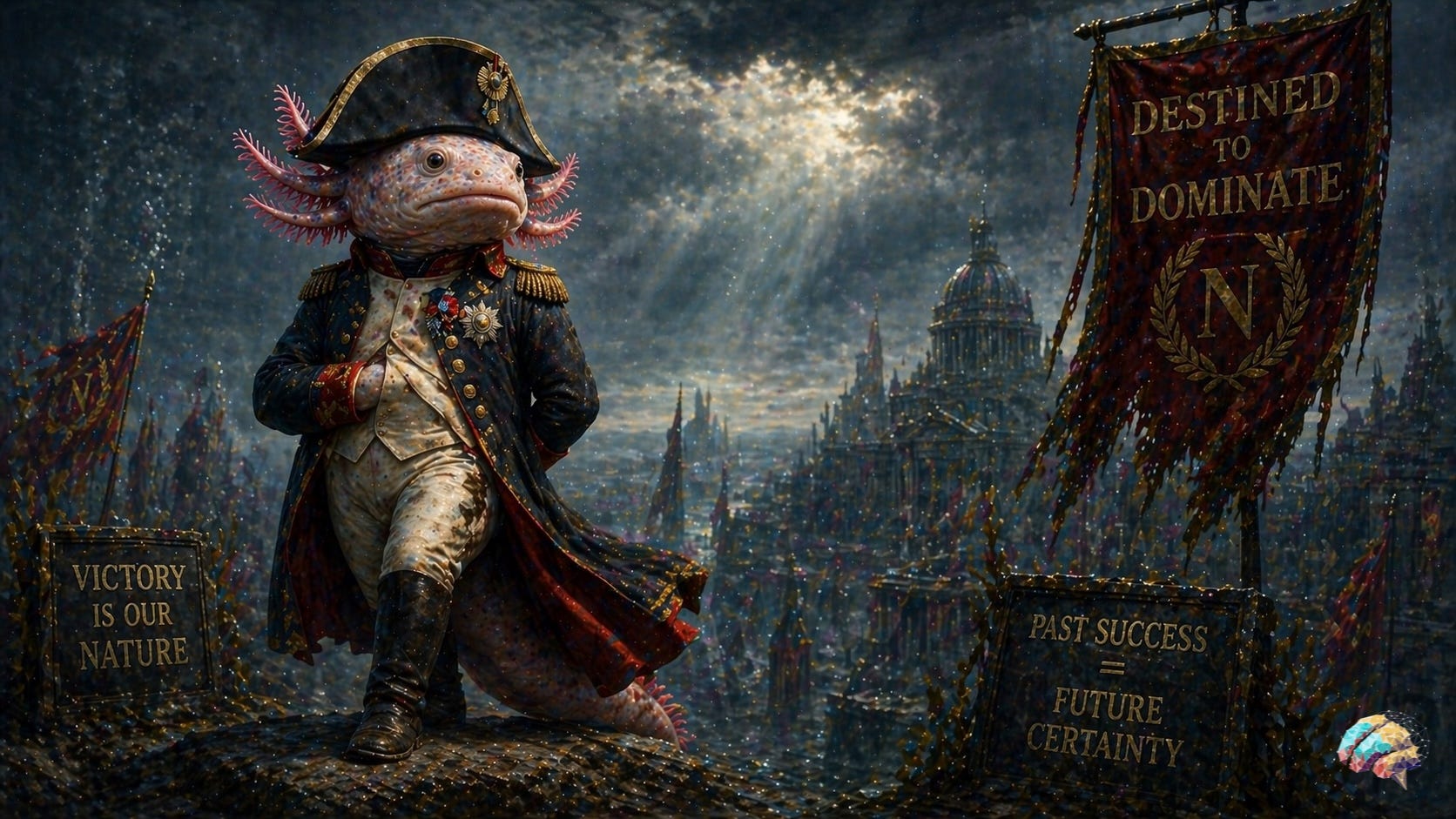
Writing in 1937, looking back at his own meteoric rise, F. Scott Fitzgerald observed that premature success gives one an almost mystical conception of destiny as opposed to willpower. At its worst, what he called the Napoleonic delusion. The company that dominated its era begins to believe it was destined to dominate, rather than that it chose to. They suffer from Victory Disease: the unshakeable belief that what won yesterday will win tomorrow.
That is the axolotl condition. Not stubbornness. Faith in a past self.
Childing

Growing up, we had a plant nursery and we grew roses. When I was young, my Dad showed me how a cluster of newer flowers had begun to grow around an older blossom. Not replacing it, not pushing it aside. Unlike a new fingernail or baby tooth, it simply added to the old, layering the new around the old, augmenting it.
It is a beautiful phenomenon called Childing.
The Collins American Dictionary defines it as “bearing a cluster of newer blossoms around an older blossom.” Such a rendering, if applied to the human condition, suggests there is no shedding of the old as we add the new, but a continual super-adding of the new to the old. Not replacement, nor abandonment, but accumulation with renewal at the edges.
This is what beginner’s mind actually means in practice. Not forgetting what you know, nor pretending to be naive. More like what this week’s guest Jeff DeGraff describes at the core of his creative framework, “a continuous loop of learning, unlearning, and relearning, not just about accumulating knowledge, but about enhancing our ability to engage with complex issues creatively and effectively. It transforms every new challenge into an opportunity for growth, ensuring that we are always evolving.”
In Zen Buddhism, the principle is called shoshin. Jon Kabat-Zinn lists it as one of the nine core attitudes of mindfulness. Jeff calls it getting back to neoteny: remaining childlike, not childish. Aristotle used the same term. Bezos built a company around it.
Picasso saw it too. Every child is an artist. The problem is how to remain one.
Not all companies that slip into Day 2 are doomed. For inspiration, we can look to one of nature’s most extraordinary creatures: Turritopsis dohrnii, the so-called Immortal Jellyfish.
If You Are Already in Day 2, There Is Still Hope
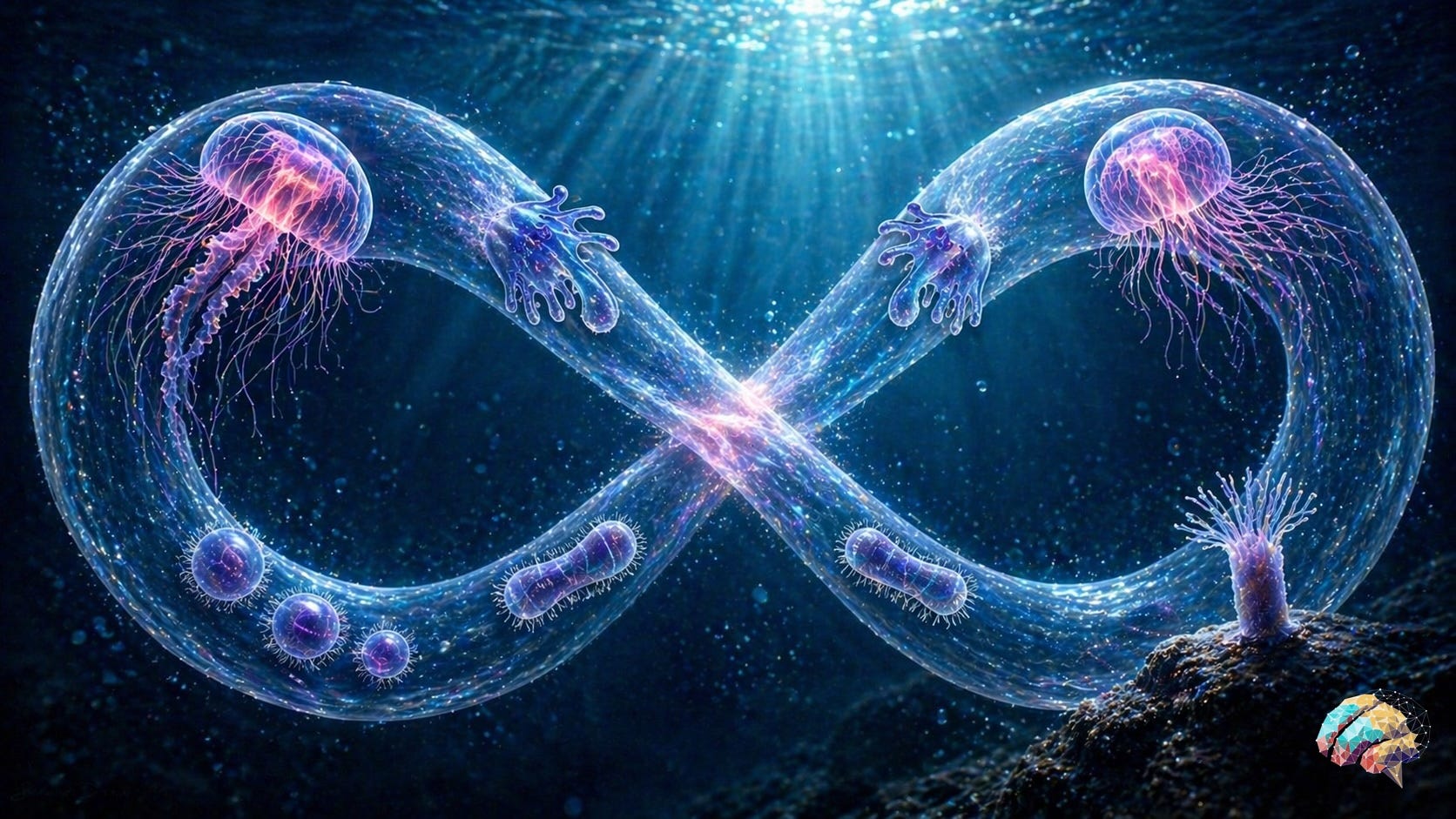
Most jellyfish have a fixed lifespan. They grow, reproduce, and die. Turritopsis dohrnii, however, has a miraculous adaptation: when stressed or aged, it can transform its mature cells back into a younger state, reverting to a polyp form and essentially starting its life over. It is as if a butterfly could turn back into a caterpillar. This process can repeat indefinitely. In 2022, scientists in Spain decoded its genetic sequence and discovered variations that make it exceptionally good at repairing DNA and maintaining chromosomal integrity. The biological equivalent of beginner’s mind, built into the organism’s very architecture.
In business, an organisation that has grown old, tired, and rigid may still have an “immortality switch” hidden in its DNA: the potential to reorganise, shed outdated habits, and regrow in new directions.
The best real-world example of a corporate immortal jellyfish, covered in my book Undisruptable is Fujifilm.
Fujifilm: The Immortal Jellyfish of Business
“A peak always conceals a treacherous valley.” - Shigetaka Komori
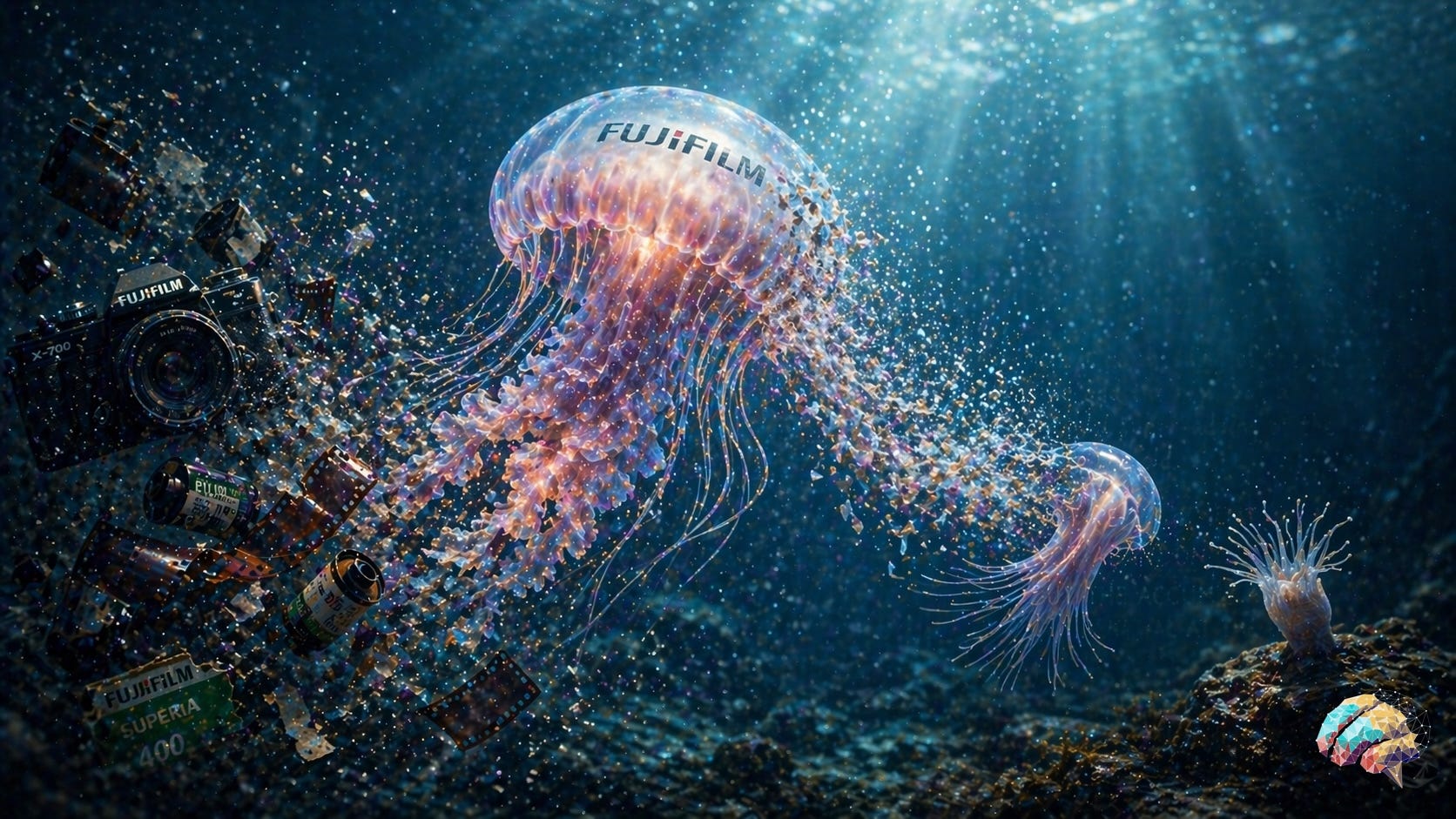
Founded in 1934, Fujifilm rose to prominence alongside Kodak as one of the world’s top photographic film makers. When digital photography emerged and threatened to make its core product obsolete almost overnight, Kodak could not let go of its lucrative film business and fell into bankruptcy in 2012. Fujifilm refused to meet the same fate.
Under CEO Shigetaka Komori’s leadership, Fujifilm asked itself a deceptively simple question, one that requires genuine beginner’s mind to answer honestly: what do we actually know how to do, and where else might that matter?
Rather than clinging to film, Fujifilm looked at the expertise built over decades: advanced materials science, chemical coatings, imaging technology, and unbundled it from the product it had always served. Its knowledge of collagen, used in film emulsions, translated into anti-aging skincare. Its imaging expertise became diagnostic medical devices, digital X-ray systems, and endoscopes. It moved into pharmaceutical biotechnology, advanced materials, and AI analytics, acquiring more than 40 companies along the way. By 2023, its medical systems and life science ventures were generating tens of billions in revenue.
CEO Komori described the mindset required with a line that deserves to sit alongside Bezos.
Fujifilm did not start over. It childed. It bore new blossoms around an older one.
The axolotl stays forever young because it never faces pressure to adapt. But that also means it never gains new capabilities. The choice for any enterprise is the same it has always been: embrace evolution and stay in Day 1, or face the gradual irrelevance of Day 2.
Beginner’s mind is not naivety. It is the discipline of continuing to ask, even when you already know.
As Bezos put it: “We can have the scope and capabilities of a large company and the spirit and heart of a small one. But we have to choose it.”
The companies that make that choice will write the future. The others will become mere case studies of what might have been.
On this week’s Innovation Show:
Jeff and Staney DeGraff join me for part two of our trilogy on The Creative Mindset. Their central argument: creativity is not a gift, it is a skill, built in small compounding moves, available to each one of us.
We work through their C.R.E.A.T.E. framework, Clarify, Replicate, Elaborate, Associate, Translate, Evaluate, and dig into the ideas that sit underneath it: beginner’s mind, neoteny, defamiliarisation, and why the hardest creative act is not generating new ideas but escaping the prison of old ones.
If you read this week’s Thursday Thought, you will hear the echo.
If you have read this far, reply to this email for your chance to win a copy of The Creative Mindset.
Part three of the trilogy, covering The Art of Change, is coming soon.