
What the Fire Eats
Turning Signals into Moves

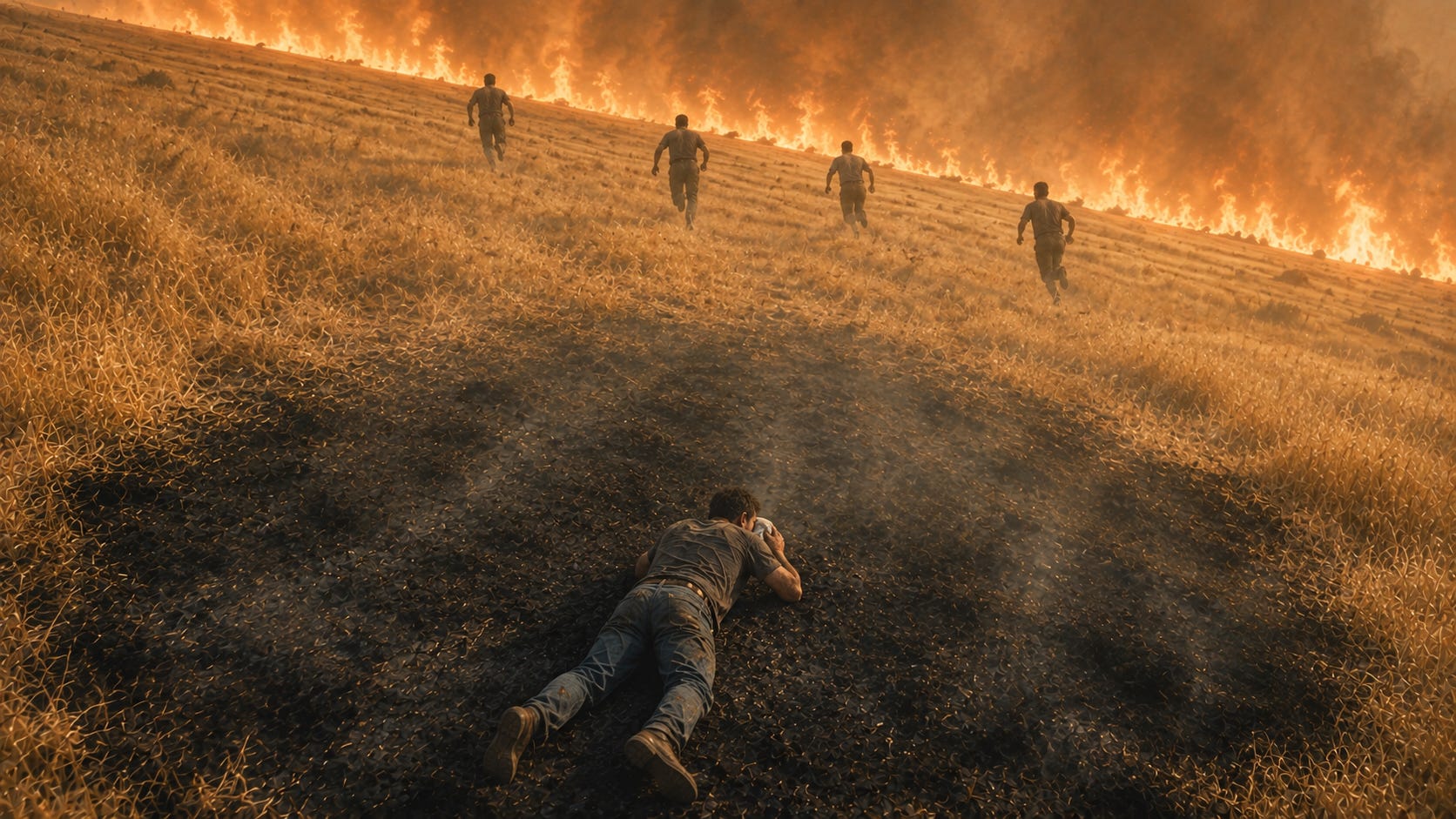
TL;DR: In a Montana canyon in 1949 the most experienced forest firefighter worked out how to survive a fire that was about to kill him. Despite his conviction, he could not persuade a single team member to follow him to safety. The answer was in plain view for all of them, thirty seconds before the fire would engulf them all. His crew thought he was losing his mind, while most of them tragically lost their lives. Seventy years later established Indian telecoms operators watched Reliance Jio give away voice and data. They fought back with a price war. Both the men who ran and the telcos who fought saw their events with complete clarity, but interpreted them entirely differently to those who took action. Why does the solution present itself so clearly to some people while it never occurs to others?
"Remove the firewood from under the cauldron" — The Thirty-Six Stratagems
Eleven Minutes in The Canyon
Imagine you are the leader of fifteen firefighters. On a hot, dry afternoon in August 1949 you parachute into a remote canyon in Montana called Mann Gulch. You are smokejumpers, an elite unit trained to drop into country too rough to reach on foot.
The plan is simple. You take your crew below the fire, because fire runs uphill and nobody wants to be caught above one. Partway down you notice the fire begin to spot, which is when embers are carried on the wind and start new fires elsewhere. One of them lands below you. Now the fire is above you and below you at once, and the ground you are standing on is the fuel.
You turn the crew and tell them to run for the ridge. You look over your shoulder and realise that you’re not all going to make it. Two of your fastest men pull ahead. Then the slowest is caught, and the others go a minute after him.
So you look around. What are your options? The slope, too steep. The fire, gaining. Rocky ground two hundred yards ahead, close enough to see but too far to reach. And then there’s the dry grass you are running through. Three of those four things you can do nothing about. The grass is the only option, the grass is the fire’s fuel.
So you burn it. You light the ground in front of you and let your smaller fire clear a patch ahead of the one chasing you. You wet a handkerchief from your canteen, hold it over your mouth, and lie face down in the ashes. When the main fire reaches the ground you have already burned, it finds nothing left to eat, and it passes around you and races on after your crew. You survive with under a minute to spare.
This was Wagner Dodge, and what he did in those last two minutes had never been done by a firefighter before. Every other man on that slope was running from the fire. Dodge was thinking about what it was eating. Gary Klein, a former guest on The Innovation Show, reconstructed the case and named his book after the heart of it, Seeing What Others Don’t.
Nobody Follows
“Knowledge is the beginning of action and action the completion of knowledge” — Wang Yangming, Instructions for Practical Living
Minutes before the end, Dodge shouted at his men to join him in the ashes. Not one of them did. Two reached the rocks he had judged too far and lived. The other twelve were caught by the flames.
The men who watched their foreman kneel down and set light to the grass in front of a wall of flame were watching something no firefighter had ever done. Robert Sallee, one of the two who survived, said:
“We thought he must have gone nuts”
At the official inquiry afterwards, both survivors testified that an escape fire had never occurred to them. The other survivor, Walter Rumsey, went further, saying that even if the technique had been explained to him and he had seen it work, it seemed too crazy to take the risk. As Gary Klein put it, it simply did not fit their “existing mental model” of what to do when escaping a fire.
What was interesting was the failure to move despite the desperation of the situation. Seeing a solution turns out to be the easier part. Doing something about it is a different story.
Fifteen Men, Same Slope
“When spring comes, snow melts first at the periphery, because that is where it is most exposed” — Andy Grove, quoted in Rita McGrath, Seeing Around Corners
Rita McGrath builds a chapter of Seeing Around Corners on that observation by Grove. Evidence of a change in the weather rarely presents itself in the executive suites. It reaches the people in direct contact with the things that are changing. It is felt by the scientist watching a technology bend, the salesperson hearing a recurring objection, the customer care team learning what customers do with a product once it leaves the building. Those are the people who see it first, they are at the edges.
Mann Gulch takes that principle to its limit, because exposure was total and evenly shared.
Fifteen men stood in the same grass on the same slope with the same fire behind them, but only one of them read the signals.
Gary Klein conducted a study on what he calls the garden path, where a team forms an early view of a situation and then sticks to it. His people built scenarios that open with an obvious interpretation and then fed in conflicting information. They ran seven teams of four through the garden paths. Not one of the seven ever got off their established path. Every team held its original belief to the end.
The interesting part is in the private notes each participant kept. In every single team, at least one member had noticed the anomalies and begun to wonder whether the original read was wrong. None of them said it aloud. Gary describes those people as the unconscious of the team mind.
The edge delivers the signal, but converting a signal into a move takes something else entirely.
A Price War, Correctly Identified
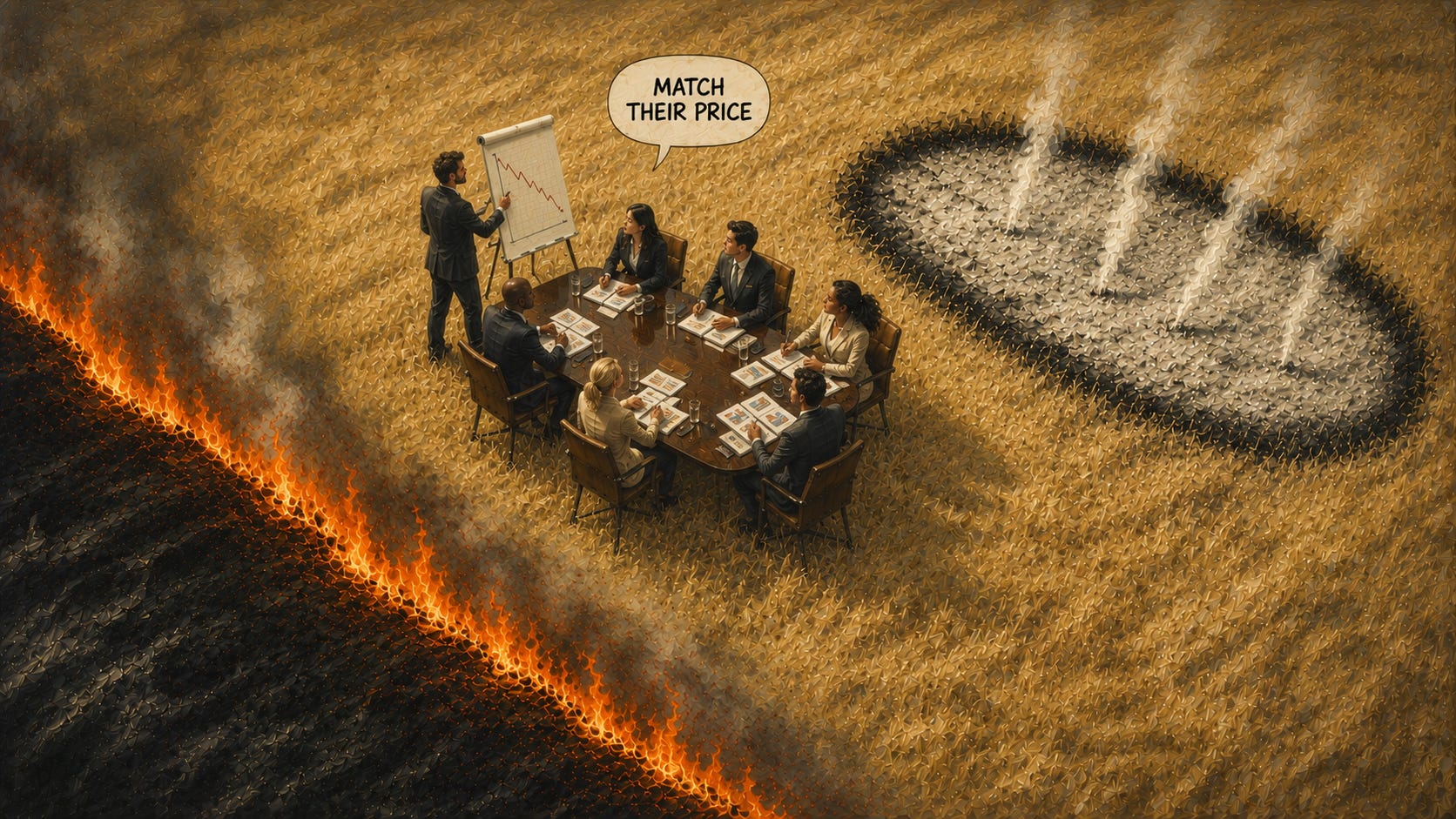
“Worldly wisdom teaches that it is better for reputation to fail conventionally than to succeed unconventionally” — John Maynard Keynes
Friend of the show, Sangeet Paul Choudary, draws a line between two kinds of uncertainty a firm can face. Operational uncertainty is what you get when the rules of the game hold and the variation happens inside them. Think of it as demand shifts, supply shocks and competitors crunching on price. Structural uncertainty is what you get when the game itself is in question.
On last week’s episode, he shared the story of India’s shift from 3G to 4G. Indian telecommunications giant Reliance Jio invested first in the infrastructure, but then did something the industry read instantly and understood wrongly. Akin to Wagner Dodge lighting his fire, Jio made voice and data close to free, and within three to four years had amassed four hundred million users.
The traditional model in that market was to spend heavily on infrastructure and earn it back on voice and data, so what Reliance had done was to set fire to the cash cow of every operator in the country, including its own. The incumbents watched the blaze unfold and reached the obvious conclusion, which was that a rival had started a price war. They knew what to do about a price war. They had seen many, and nobody was ever blamed for waging one. They fought fire with fire, and the market shrank from twenty or so players to two or three.
Reliance had removed the firewood from under the cauldron. Voice and data were the ground the whole industry was standing on, and once that fuel had been burned off, the four hundred million people who had come for free connectivity were arriving through a choke point that Reliance owned, on their way to content, commerce and everything stacked above. Rival telco Airtel first read it as a price war, but then read it again. Once they understood what game was being played, and that the uncertainty was structural, they changed their own game. Airtel did what Dodge did. They looked again at what the fire was eating.
The Giraffe and the Orange Hat
“Essentially, all models are wrong, but some are useful” — George Box and Norman Draper, Empirical Model-Building and Response Surfaces
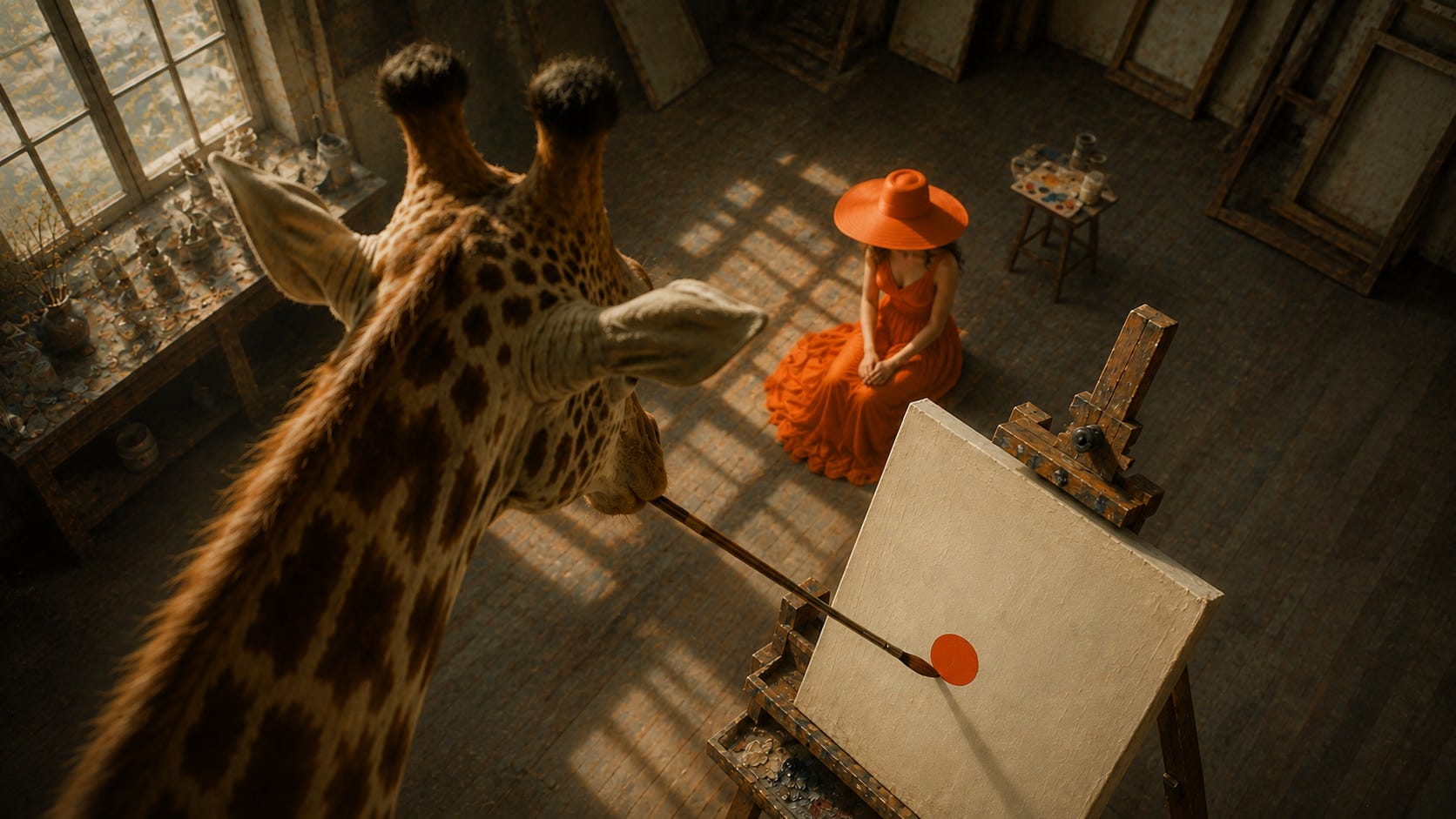
There is an image I use in workshops. A giraffe stands at an easel, painting a portrait of a woman in an orange hat. Looking straight down at her from its considerable height, it has produced a single orange dot. From the giraffe’s perspective the picture is accurate. Everything the giraffe can see is represented on the canvas, rendered faithfully in good faith from the only position available to it.
A model is a lens, and a lens that has worked for twenty years stops feeling like a lens at all. It begins to feel like eyesight.
The Indian operators were running a model of their industry that had been accurate for decades and had a slot marked price war, so a rival cutting prices went into that slot and the model returned its correct response, which was to cut prices.
The smokejumpers were running a model in which fire is the enemy and high ground is safety, and it emitted the answer that had kept firefighters alive for as long as there had been firefighters, which was to run.
Every model holds inside it a boundary. It works in the conditions it was initially built for and stops working when those conditions change, and the difficulty is that the boundary is invisible from inside. We do not experience our assumptions as assumptions. We experience them as the situation, and after long enough we mistake the edge of the rut for the horizon.
If you missed last week’s show
Rita McGrath and Sangeet Paul Choudary joined me for the conversation behind this piece, on structural uncertainty, Reliance Jio, and what to do when someone rejects your model outright. The giraffe also makes an appearance.
Tomorrow on The Innovation Show

What if most project failures had nothing to do with project management? Not the missed deadlines or the flawed Gantt charts, but leadership blind spots and organisational structures that were never designed for a world run on projects.
Antonio Nieto-Rodriguez coined the term project economy in 2019. His new book, Powered by Projects, argues that every organisation is now project-driven and almost none of them behave like one. Each of us is a project manager, whether we know it or not.
You can win a copy of the book, with thanks to our sponsor Kyndryl, just sign up for the Institute here and send us a screenshot to be in to win.