The Mirror in the Machine
Why the systems we build reflect the organisations that built them, and why AI is about to make that impossible to ignore

TL;DR: In 1968, Melvin Conway observed that organisations design systems that mirror their own communication structure. What Baldwin and Clark later proved, and Henderson and Clark explained, is that the mirror runs both ways. The product shapes the org, and over time the org constrains the product. The knowledge that holds this architecture together becomes embedded and invisible until a new architecture makes it obsolete. The challenge for an incumbent is that they can only see through the lens of the architecture they have built. They carry technical debt and psychological debt. When an entrant arrives with no legacy, they can build for the needs of the customer from today forward, unburdened by the past. AI offers a new architecture that is forcing organisations to reorchestrate their entire stack — technological and psychological. Most companies are responding to it by updating components while their organisational structure remains intact. That is the source of the whiplash many are experiencing today.
"In nature, structure and function go hand in hand." — Iain McGilchrist, Ways of Attending
The Map Inside the Brain

To earn a black cab licence in London, a driver must memorise 25,000 streets, thousands of landmarks, and the most efficient routes between any two points in the city. The process takes around two years on average and is known simply as the Knowledge. What Eleanor Maguire and her colleagues at University College London discovered in 2000 was that this process does something measurable to the brain itself. The posterior hippocampus of licensed cab drivers (the region associated with spatial navigation) was significantly larger than in non-drivers, and the longer a driver had been working, the more pronounced the difference. The brain had not merely stored a map. It had restructured itself around the demands of the work. Structure and function, as McGilchrist observed, go hand in hand.
This is worth holding in mind when you consider what Tom West found when he dismantled a DEC VAX computer one morning in 1978.
The Machine and the Organisation
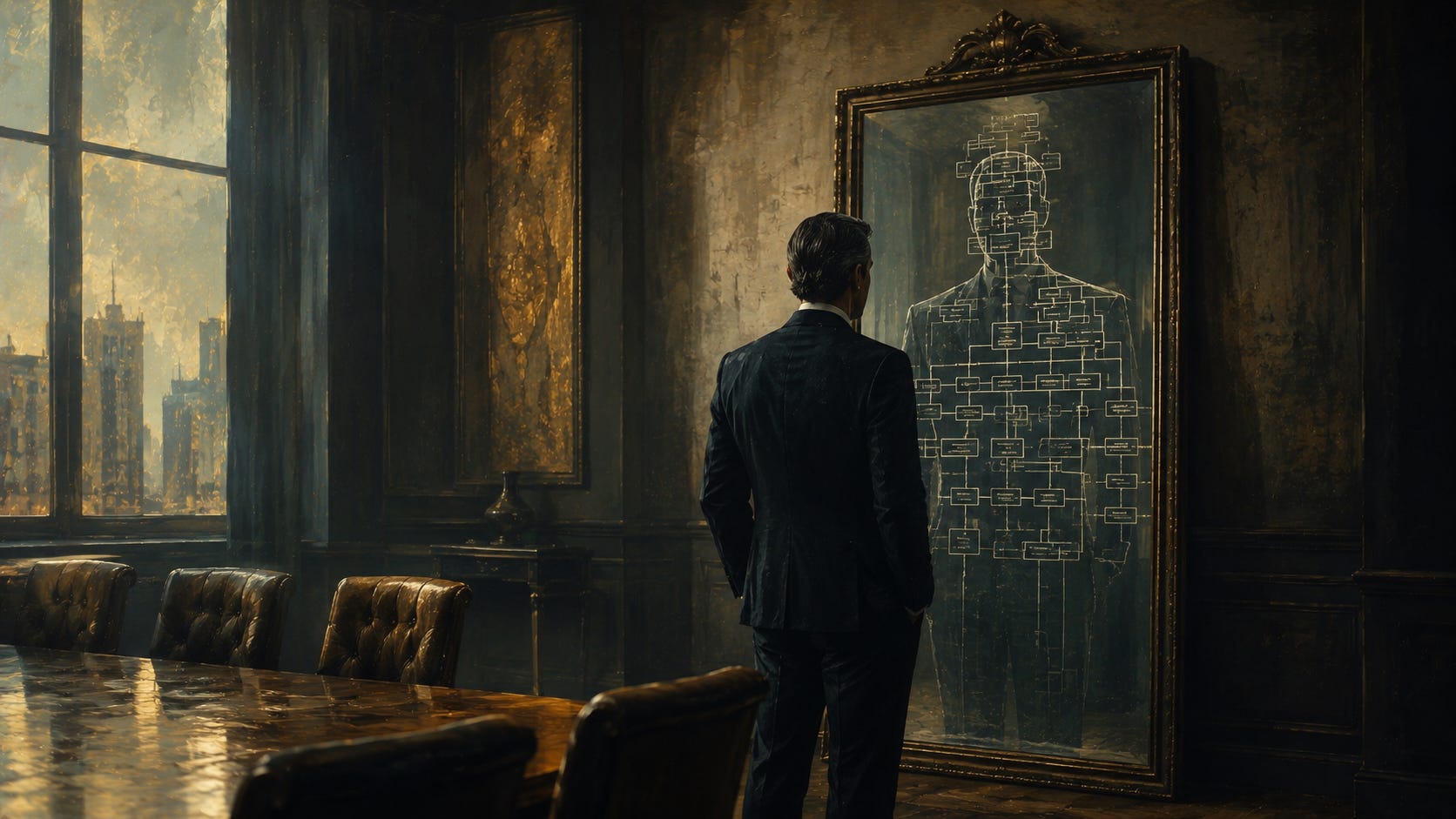
Tom West was an engineer at Data General, a rival to DEC in the minicomputer market. He had spent a year living in fear of this new machine, the VAX. When he finally gained access to one, he removed the cover and spent the morning examining what was inside. What he found, as Tracy Kidder recounts in The Soul of a New Machine — his Pulitzer Prize-winning account of the real engineers racing to build a new computer in the late 1970s — was not what he had expected. Peering into the machine, West came to feel he was looking at a diagram of DEC’s corporate organisation. The VAX was too complicated, too much protocol between its parts. West realised the product was a physical manifestation of DEC’s cautious, bureaucratic culture.
Rebecca Henderson and Kim Clark were among the first to establish that this intuition was far more than that.
Design Rules
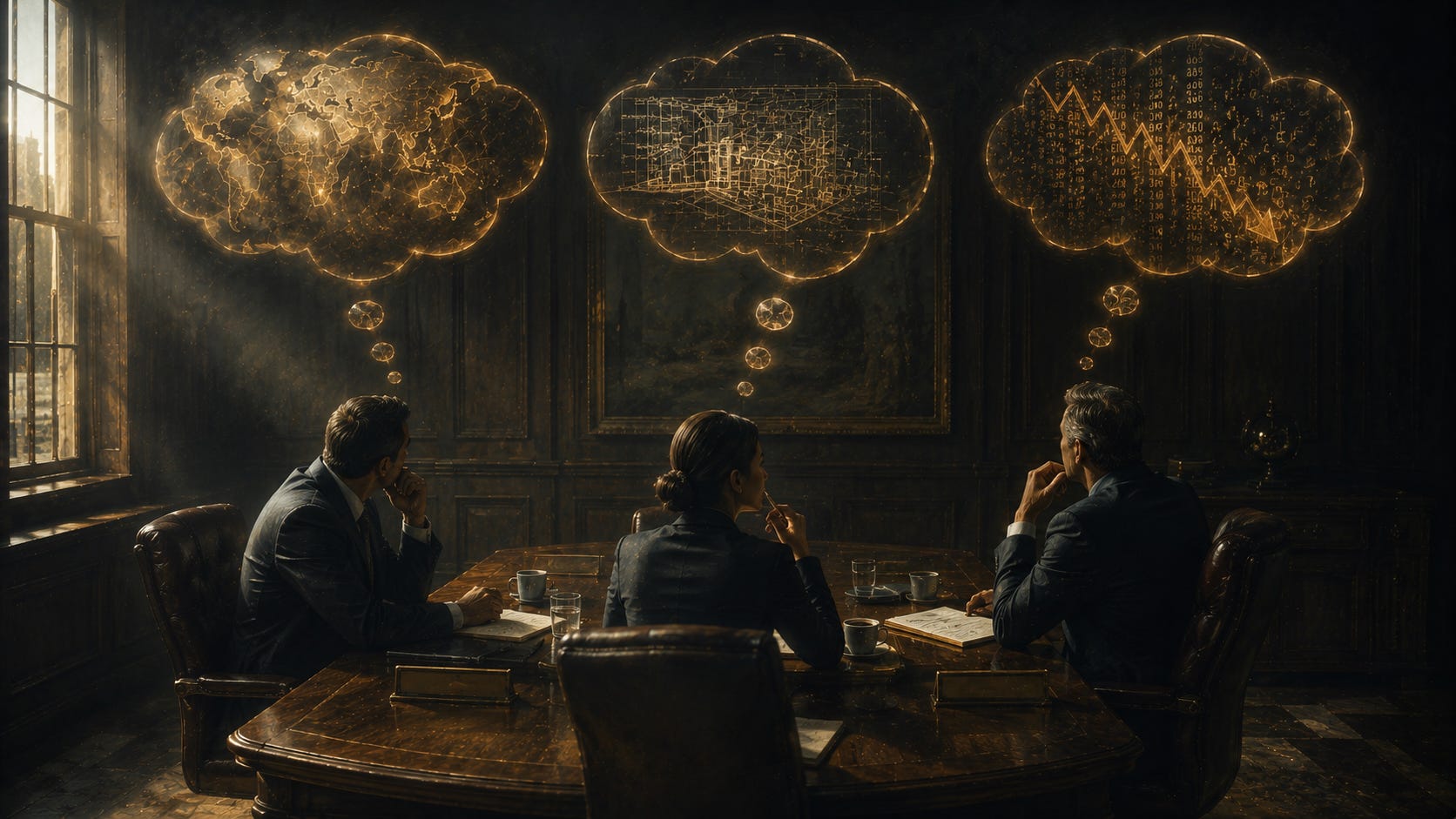
"Where you stand depends upon where you sit." - Rufus Miles
Carliss Baldwin and Kim Clark took the insight even further. In Design Rules: The Power of Modularity, the then-Harvard Business School researchers documented one of the most consequential and arguably least-known findings in organisational science.
The architecture of a product and the structure of the organisation that builds it do not develop independently. They mirror each other with striking and structural consistency. In the early life of a company, the product’s architecture determines how the organisation divides its work. The design comes first and the structure follows. But as the organisation matures and specialises around its modules, the relationship inverts. The boundaries between departments come to mirror the boundaries between components. At that point, the organisation is no longer shaped by the product it is currently building. It is shaped by the product it once built.
Most leaders have never encountered Baldwin and Clark’s work. Most are living inside its consequences without knowing it. The phenomenon is profound but invisible. When you understand it you can do something about it.
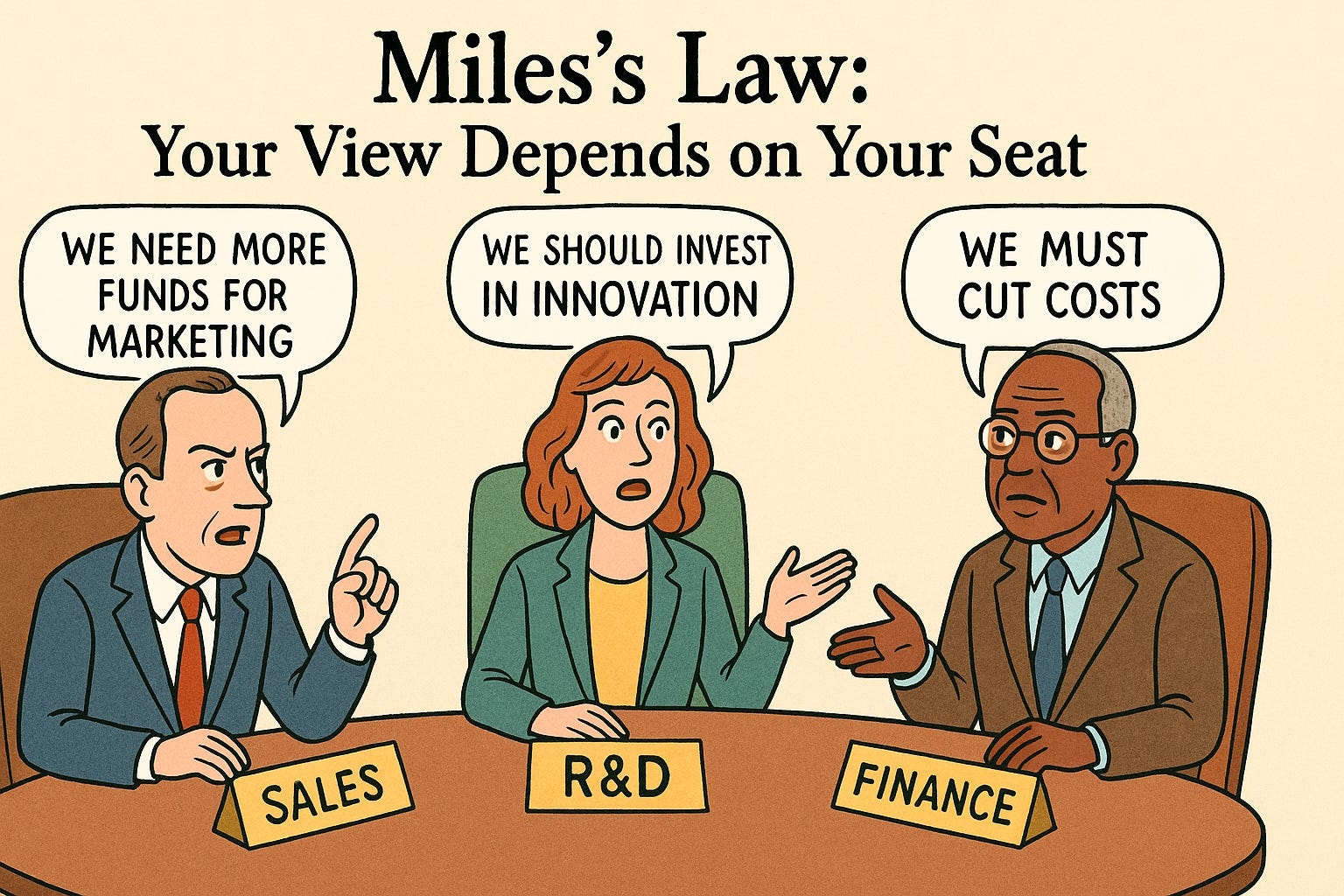
Miles's Law, named after the American civil servant Rufus Miles, adds the human dimension the framework implies but does not quite state. Where you stand depends on where you sit. The position a person occupies in an org structure shapes what they are able to see within it. The cab driver's brain grows into the map of the city. The executive's thinking grows into the org chart — and any new product or service born from that chart is burdened with the genes of the parents.
The Egg, the Chicken, and the New Species

A COO at a major bank, when I explained the article I was working on, said it sounded like a chicken and egg problem. I suggested it was more specific than that. It is an egg that creates a chicken, which then creates a hybrid egg, which demands a new species entirely — because the hybrid egg has already been shaped by the genetics of the chicken that laid it. You cannot hatch your way to a genuinely new form. You need what evolutionary biology calls punctuated equilibrium: a break in the pattern, not a continuation of it.
He sat with that and then said: this is exactly what happens to legacy banks. Along comes a fighter bank like Revolut. No inherited architecture, no accumulated plaque of past decisions, previous status or corner office politics. They build from the customer need outward. But then Revolut itself will inevitably face the same cycle. The entrant who wins becomes the incumbent who struggles. The new species lays its own eggs. The architecture that liberated them becomes the constraint that limits them.
Going back to first principles is the only exit from the cycle. And in the age of AI, first principles means a total reshuffle of the stack, both technological and psychological.
The Knowledge That Disappears
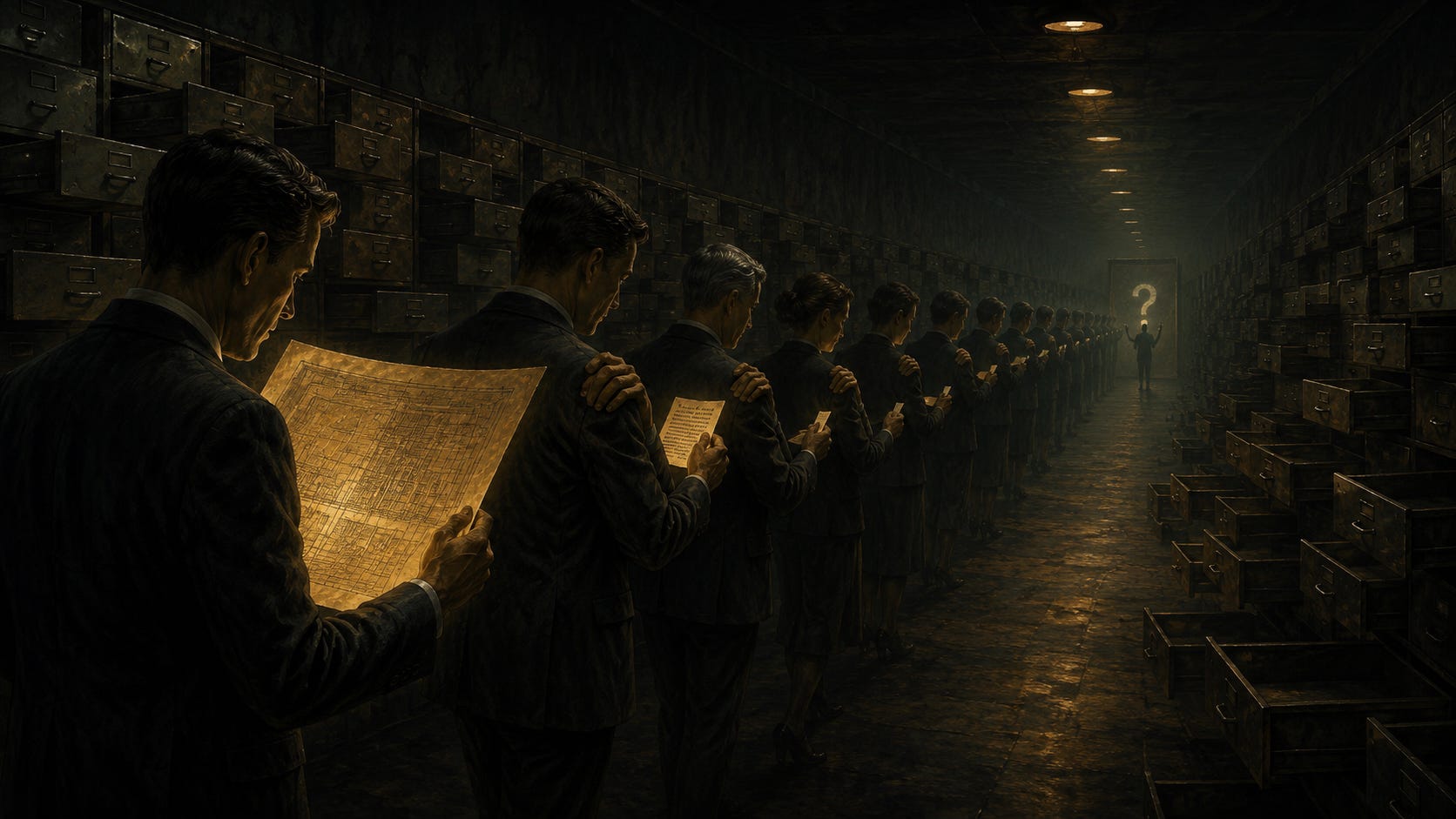
Henderson and Clark’s 1990 paper, published in Administrative Science Quarterly, explains why this is so difficult to see from the inside. As a dominant product design matures, the architectural knowledge that holds it together stops being managed consciously. It marinates into the organisation’s communication channels, its information filters, its problem-solving habits, the very questions it asks.
The people who work on a computer’s motor and the fan blade report to the same supervisor and meet weekly. That meeting schedule is a physical expression of the company’s knowledge about the relationship between those two components. Over time, this kind of knowledge becomes so embedded that it operates without anyone noticing it is there.
Stewart Brand observed in The Clock of the Long Now that legacy systems make themselves so essential over time that no one can contemplate replacing them, and eventually there is “no one left who understands the whole system.” The organisation keeps running. The knowledge that explains why it runs the way it does has dissolved into the structure itself.
The danger arrives when the architecture changes. We are living through exactly such an architectural shift now. AI is not a new component in an existing tech stack, it is rewriting the foundation of the stack itself, dissolving the interfaces between roles, departments and systems that organisations have spent decades building around.
Henderson and Clark studied the semiconductor chip manufacturing industry through four successive waves of innovation to show how this plays out. In each case, the established market leader failed to make the transition. This was not because they lacked skilled engineers, but because their knowledge and information-processing structure had come to mirror the internal structure of the product they were designing.
Consider the company Kasper Instruments. They made machines that printed circuit patterns onto silicon wafers by pressing a template directly against the surface. They were exceptionally good at it. Then Canon introduced a machine that held the template a tiny distance above the surface instead of touching it. This was a small change in architecture, not in components. When Kasper’s engineers evaluated Canon’s new machine, they pronounced it “merely a copy” of their own. The features that made Canon’s machine a significant advance were invisible to them, because they were looking through filters built for the old method. The knowledge they needed had been rendered invisible by the very success of what they already knew.
The pattern repeated at Nokia, at a scale the entire world witnessed. When the iPhone arrived in 2007, Nokia’s intelligence team had been tracking the threat for years. Timo Partanen, who led Nokia’s strategy and market intelligence function during that period, shared his account on The Innovation Show. The device itself was not the surprise. “What surprised us,” he said, “was the ecosystem that Apple was able to build around it.”
Nokia’s filters were built for hardware. The organisation had become the world’s dominant mobile phone maker by competing on specifications, and its information channels, communication structures, and problem-solving habits had all been shaped around that competition. When Partanen’s team presented the iPhone threat to leadership, they saw it through those same filters. The software architecture, the developer ecosystem, the carrier partnership — these were architecturally new, and the organisation had no channel for them. As Timo put it: “Nokia’s working mentality at that time was very much about hardware specifications. We didn’t necessarily understand the business side of the aspects they were developing, their partnerships, their collaboration agreements. That was a blind spot.”
The CEO knew Symbian was inadequate. But researchers Quy Huy and Timo Vuori, who conducted more than a hundred interviews across Nokia for their landmark study of the collapse and who shared their findings on The Innovation Show, documented what followed. He felt he could not speak about Symbian’s problems because there was no alternative. “Because he didn’t bring it up,” Vuori told us, “no one dared to bring it up, and so they didn’t develop those options.” The middle managers, meanwhile, were not afraid of the iPhone. They were afraid of their bosses. The threat that dominated their attention was not Apple. It was the reaction of the person above them in the org chart. The filters built for internal hierarchy screened out the signals that should have driven action on the external architecture.
Nokia’s organisational structure had grown into the shape of the product it had mastered. When the architecture changed, the structure could not see the change clearly enough to respond to it. Kasper and Nokia are separated by three decades and entirely different industries. The mechanism is identical.
The cage is invisible, and the cage is architectural.
The Building That Knew What to Do

During a visit to Johannesburg to run a workshop for a client, I was invited by Discovery’s founder and CEO Adrian Gore (a forthcoming guest on The Innovation Show) for a tour of their purpose-built headquarters. Neither of us could have anticipated how directly it would speak to this article. Hylton Kallner, CEO of Discovery Bank, shared some key insights.
Discovery brought together 5,000 employees who had previously occupied four separate buildings into a single headquarters designed, in the architects’ own words, from the inside out. Each floor houses a different business unit — Discovery Bank, Discovery Health, and the various adjacencies the company has grown over the years. Two vast atriums run through the building. Hylton described them as lungs, deliberately designed to breathe life between the floors and create the connective tissue between otherwise distinct businesses. Then he showed me the top floor. He proudly shared how most organisations reserve that space to the executive suite, the position that signals power and status in a building. Discovery gave it to a gym, an outdoor running track, and football pitches. Hylton told me this was a deliberate statement about what the company actually values. Every floor has a barista. Customers receive Apple Watches and Oura Rings and maintain their membership by demonstrating that they are using them.
When I asked whether the IT architecture followed the same logic as the building, Hylton smiled and said that most people never ask that question. Yes, he said. The systems mirror what we have built here. Just as the atriums create common threads between the businesses in the physical space, the digital architecture does the same — and the data is the air that breathes life across the corporate body.
Discovery had done what Baldwin and Clark describe, but consciously and in reverse. They had recognised that structure and function shape each other and had designed both together with intention. The building was a consequence of the organisation, and the organisation was a consequence of the building, and both were consequences of the same thinking about what the company was for.
The Coordination Rupture

This is the context in which friend of the show and regular guest, Sangeet Paul Choudary’s Reshuffle lands perfectly. Choudary’s core argument is that AI functions primarily as a technology of coordination or re-orchestration. Previous waves of technology changed what tasks could be performed and how quickly. AI changes the cost and structure of the coordination between tasks, dissolving the interfaces that once defined where one role ended and another began. Knowledge that was bundled into a single job because a human being had to carry context between its components can now be unbundled. New workflows emerge that do not map to existing org charts.
In Henderson and Clark’s terms, this is an architectural innovation, the kind that embedded organisational knowledge is least equipped to recognise. The filters and lenses built for the old architecture screen out the signals that would warn the organisation its structure is becoming obsolete. For most organisations, the response to AI has been to update components (add tools or automate individual tasks), while the very architecture beneath them is being restructured. The result is organisational whiplash: the strain of applying a new coordination logic to a structure designed around an old one while trying to move as fast as possible.
The Question Worth Asking
In my talks and roundtables with leadership teams, the moment this framework makes sense when I ask them to consider what product architecture their organisation was originally built to serve. For most, the honest answer is that they have never been asked to think about it in those terms. The org chart has always felt like the thing itself rather than a consequence of something else. The idea that it might be a shadow cast by decisions made decades ago about how to divide a product that no longer exists tends to be disorienting in the way that genuinely useful reframes are.
Baldwin and Clark wrote their book at a moment when the modular era of computing was reshaping an industry. Their framework described that moment with precision. Henderson and Clark showed why the transition was so hard: the knowledge that should have guided incumbents had become invisible, embedded in the very structures that now prevented them from seeing clearly. What neither could have anticipated was a technology that would dissolve modular boundaries themselves rather than merely redraw them. That is what makes reading Reshuffle alongside Design Rules so clarifying. Baldwin and Clark explain why your organisation is the shape it is. Henderson and Clark explain why that shape is so hard to see. Choudary explains why it is about to become a problem.
The cab driver’s hippocampus grew into the map of a city.
Discovery’s building grew into the shape of its business, and its business grew into the shape of its building.
The question for leaders is which map your organisation has grown into, and whether that is still the city you are trying to navigate.
And for the entrepreneur, the question inverts.
The incumbents in your industry are pressing levers that no longer connect to anything. Which lever is it? And how long before they notice?
To celebrate the five-year anniversary of Re:Think Innovation, we welcome the author on a mission to teach one million people to do exactly that. Carla Johnson joins us on tomorrow’s show.
We hear the cautionary tale of the pet water company that mistook a gap on the shelf for a genuine opportunity, and the story of Mohammed, the founder whose Disney-inspired strategy was killed in a single meeting by the executive Carla calls the CF-uh-O. We cover Brand Detachment Disorder — “that would never work here” — the psychological protectionism that stops organisations learning from anyone outside their own industry, and complexity bias, our tendency to believe an idea is only valuable if it’s complicated, when the truly hard part is making it simple.
Along the way: how London’s Great Ormond Street children’s hospital cut surgical handover errors by learning from Ferrari’s Formula 1 pit crew, why 90% of innovation happens outside the R&D department, and what it takes to become a perpetual innovator — someone who consistently produces ideas that are new, great, and reliable.