
The Ground Remembers
Tacit Knowledge in the Age of AI


TL;DR: Landscapes, bridges, and organisations all carry knowledge embedded in practice rather than documentation. When that practice is rationalised away or a long-time staffer leaves without a proper debrief, the knowledge disappears too. The same risk now applies to the tacit understanding we delegate to AI. Each time we accept the output without building our comprehension, the population capable of questioning the answers gradually shrinks.
“Institutional memory, and its attendant facts and knowledge, are only as permanent as its generation time.”— Samuel Arbesman, The Half-Life of Facts
What Grandma Knew

Before refrigeration, cinnamon and cloves were not primarily flavouring agents. Cinnamon contains cinnamaldehyde, a compound with strong antimicrobial properties that inhibits bacterial and fungal growth. Cloves contain eugenol, which works in a similar way and was used as a preservative across many cultures long before anyone could name the chemistry. In a kitchen without cold storage, apples sitting out were often turning. The spices slowed that process, masked the early edge of fermentation, and made the tart safe to eat. They also aided digestion, and at a time when spices were expensive and rare, a well-spiced tart announced something about the household that produced it.
When refrigeration arrived, the functional need disappeared, but the recipe remained, and with it, the cinnamon.
Ask a home baker today why they add cinnamon and cloves to an apple tart, and the most honest answer is: because the recipe says so, or maybe because it tastes better. Press a little further and the answer becomes: because that is how we always did it.
The recipe, in most cases, came from a mother or grandmother, who received it the same way. The spices taste right because they always have. The dish feels incomplete without them because it always did.
What has been lost along the way is the reason those spices were there in the first place.
Nobody removed it because it tasted good, and because removing a thing that works feels like an unnecessary risk. But the knowledge of why it was there had already slipped quietly out of the tradition. The practice survived. The rationale did not.
This is how most tacit knowledge travels. It is folded into habit and passed forward without explanation, preserved in the doing rather than the understanding. It works until someone decides to rationalise the recipe, and finds they cannot reconstruct what they have lost.
The Hedge That Remembered
Over a decade ago I planted hedges along the boundary of our garden. Season by season they thickened and rose to about ten feet. Except for one section, which consistently lagged behind. Years earlier a road had once run through that point, but the developer decided to turn it into a cul-de-sac. The result was that the ground there was compacted, tarred and covered with a thin layer of topsoil. Even after I replaced the soil it took longer to recover.
I had told the previous landscaping contractor about this. He and his team trimmed regularly but never cut that section back aggressively. They understood it needed to be treated slightly differently.
Then, unbeknownst to us, the management company hired a new contractor.
Without warning they levelled the entire hedge down to its lowest point. From their perspective it looked uneven. The logical solution was to standardise it. They thought we would be pleased.
In a single afternoon they culled years of growth. What they could not see was the history embedded in the hedge. What looked like inconsistency was tacit knowledge in action.
Organisations carry a similar kind of memory. Walk through any company that has been around long enough and you will notice oddities. Certain teams operate to a different playbook. Some processes appear more complicated than they need to be. A handful of workarounds remain embedded in otherwise standardised systems. To a newcomer these irregularities look like inefficiency. Their instinct is to simplify, to align everything to a common baseline.
A tale of a bridge in Washington might change their opinion.
The Bridge That Fell in Four Months
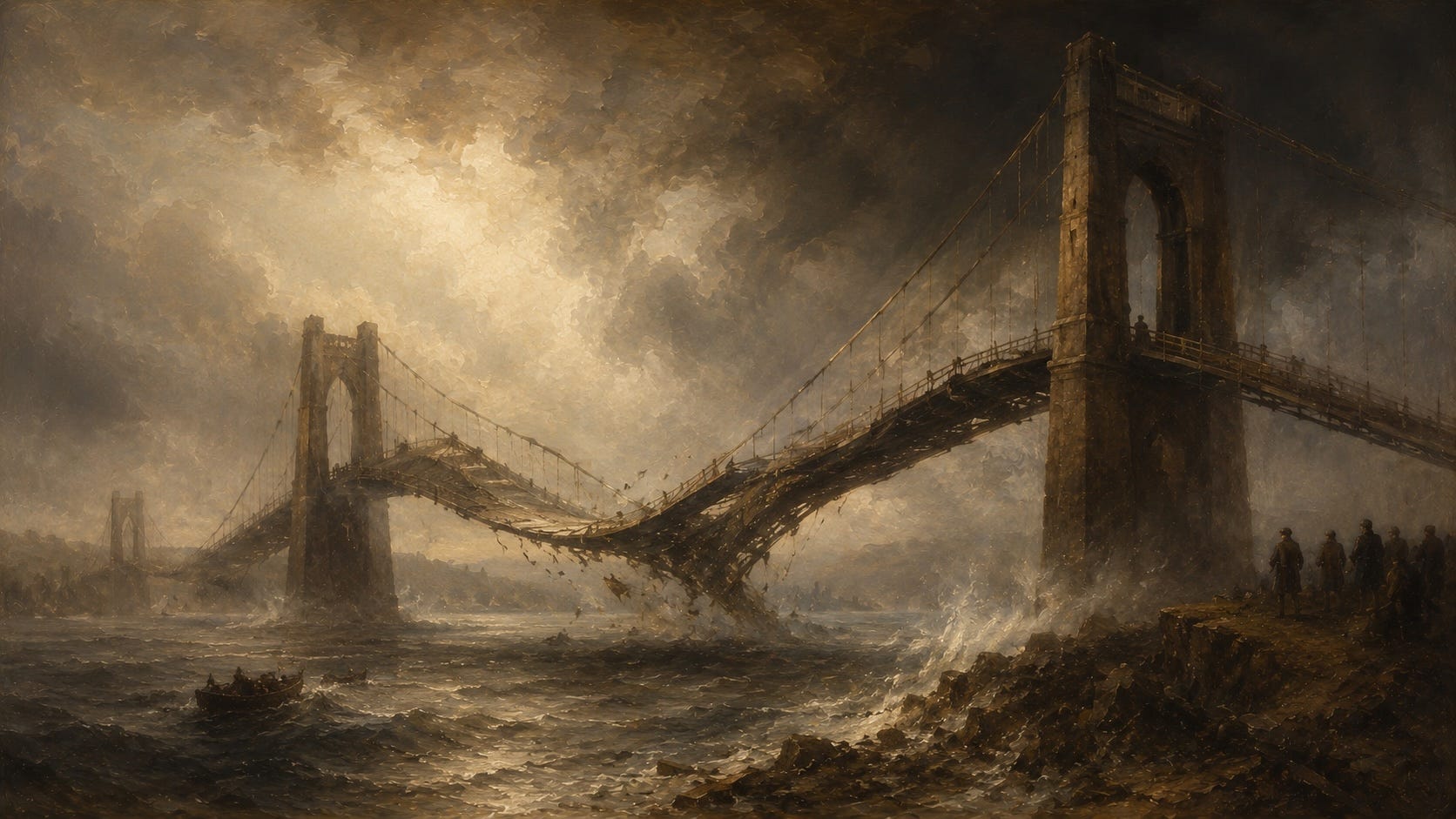
“Established rules of thumb, probably derived from some long-forgotten process of trial and error, sufficed to meet traditional requirements.” — Carliss Baldwin and Kim Clark, Design Rules: The Power of Modularity
In 1938, Washington State engineers drew up plans for a suspension bridge across the Tacoma Narrows. The conventional design called for 25-foot-deep trusses beneath the roadway, stiffening it against the wind. This was the standard approach, built from decades of accumulated experience about how bridges behaved in weather.
Then a celebrated New York engineer named Leon Moisseiff intervened. He had successfully consulted on the Golden Gate Bridge. He had published what was considered the most important theoretical advance in bridge engineering of the decade. His calculations showed that 8-foot plate girders would do the same job for considerably less money and with considerably more elegance. The state of Washington backed him.
The bridge opened on 1 July 1940. Workers had nicknamed it Galloping Gertie during construction, because it swayed noticeably in moderate winds. Engineers attached cables and dampers to reduce the motion. None of it worked. On 7 November 1940, four months after opening, the bridge collapsed into Puget Sound.
What Moisseiff’s theory had not accounted for was aeroelastic flutter. The previous designs’ deep trusses had allowed wind to pass through the structure. The new solid plate girders diverted wind above and below the deck, creating self-reinforcing oscillations that increased without limit until the structure failed. The old engineers had not known that this was why deep trusses worked. They built them because deep trusses were what you built. The knowledge lived in the practice, not in any written rationale.
When a new rationale arrived, dressed in elegant mathematics, it replaced the practice. The map, for all its precision, was not the territory it claimed to describe, and in the end the bridge gave way.
The Hood That Should Never Have Vibrated
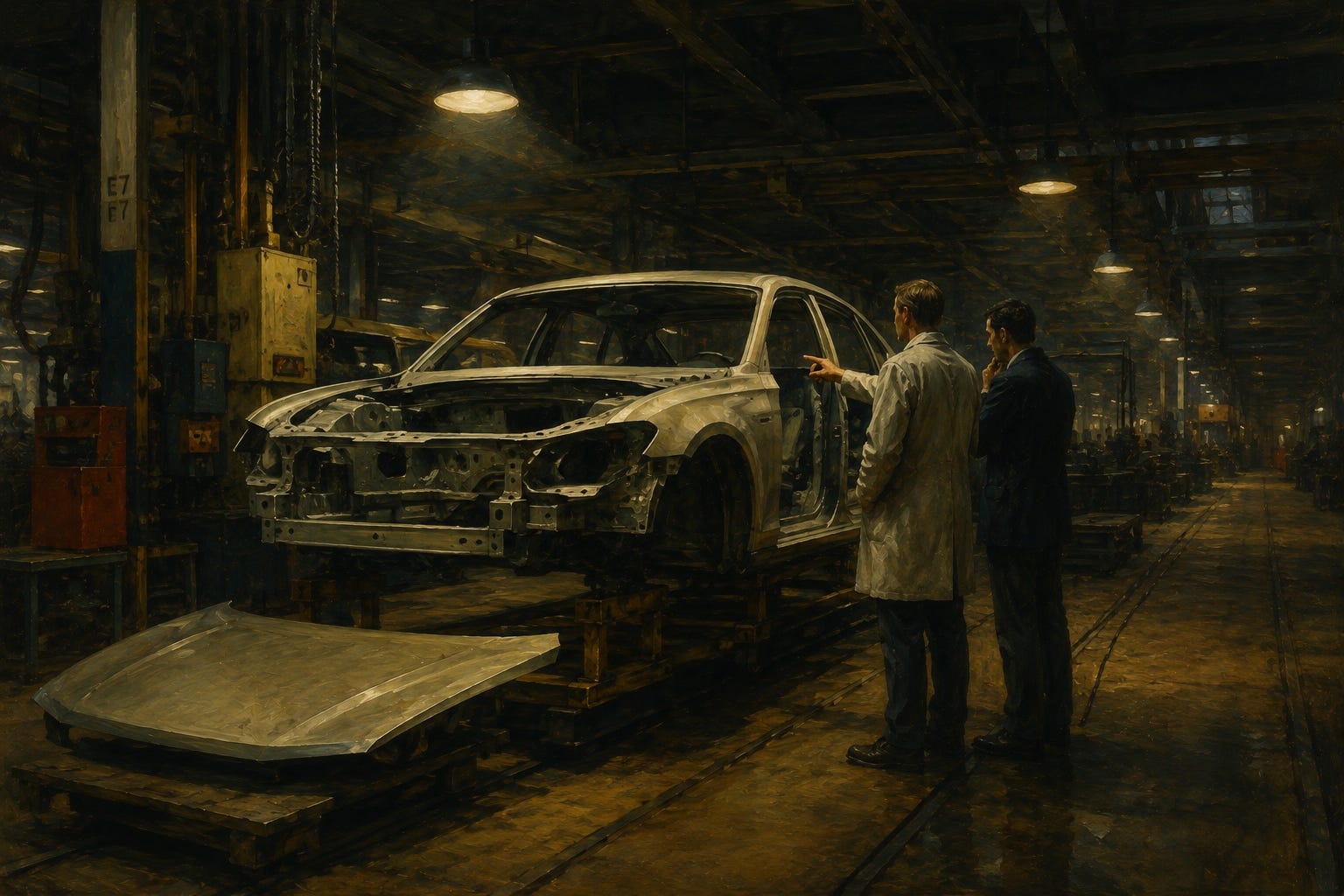
A more contained version of the same pattern appeared in the American automotive industry a generation later. As manufacturers moved from large cars to small ones, the engine compartment shrank, the hood that covered it had far less room, and the new hoods began to vibrate. Engineers investigated.
Kim Clark, co-author of Design Rules, told the story on a soon-to-be-released episode of The Innovation Show. For years engineers had known how to package an engine compartment so that the noise and vibration of the car stayed within pleasant limits, and none of it had ever been written down. It was knowledge worked out by people who knew where to put things and how the vehicle behaved. When the cars shrank, that feel no longer held, and on the first test drives the thin steel of the hood waved visibly across its surface. The problem was never the smaller car, but that the knowledge which had solved the old one had never been captured at all.
Kim Clark calls these the “hidden rules of thumb” that sit underneath a working system, the fixes embedded in practice that nobody records, along with what they were fixing, or why.
The recipe. My hedge. The bridge. The hood. The mechanism rhymes each time. Something works. Nobody asks why. The why gets removed when a new contractor, a new engineer, or a new executive arrives with a mandate to standardise or to eliminate what they perceive as slack in the system.
The Answer Without the Understanding
“Institutional memory, and its attendant facts and knowledge, are only as permanent as its generation time.” - Sam Arbesman
Every restructuring, every round of outsourcing, every exodus of long-serving staff reduces the population in which certain knowledge lives. At some point that population drops below what the knowledge needs to survive.
This is worth sitting with when the question turns to artificial intelligence.
AI systems are genuinely good at producing correct outputs. They compress expertise across domains into answers that would have taken years of experience to arrive at. The usefulness is real. But when an organisation delegates its diagnostic reasoning to a model, or its pattern recognition, or its sense of what is normal and what is anomalous, the humans in that organisation gradually stop building the tacit understanding that underlies those judgements. They receive the answer without developing the comprehension.
We have always offloaded knowledge this way. The recipe lodged the reason for the spices inside a practice, and the hedge lodged it inside a contractor who had walked the boundary and knew where the road had once been. Offloading is not the weakness. It is how any group holds more than a single head can carry, by placing what it knows in people, in habits, and in the things it builds. The failure comes later, at retrieval, either because the store is gone, the contractor moved on and the engineers retired, or because the store survives while the reason drains out of it, the way the recipe kept the spices long after the reason for them was gone.
Arbesman returns to this in a later book on technological complexity. The most capable systems, he notes, reach their conclusions by routes that cannot be restated as a rule a person could follow. The result works, and yet we are, in his phrase, “missing insight into the process by which it came to be an answer.” This is a sharper loss than the others. The knowledge in the hedge and the bridge existed once and could, with effort, be recovered. The route an opaque system takes to its answer may never have taken a form a person could hold.
Like Moisseiff’s equations, the output is valid for the conditions in which it was trained. When conditions change, the person who should be able to interrogate the result may no longer have the capacity to do so. It is like the patch buried in a legacy IT system, the one that forces a company to call a former colleague out of retirement to explain it.
The risk is not that AI produces wrong answers, but more that we progressively lose the ability to recognise when the answer is wrong.
What Grew There Before
The hedge will grow back. Plants are resilient. Given time the height will return.
The bridge has been on the floor of Puget Sound since November 1940. The knowledge about trusses took a generation to rediscover, then reframed as aerodynamic engineering. The auto engineers eventually worked out why the hoods had vibrated, but they had to do the forensic work that the rules of thumb had always made unnecessary.
What looks like inefficiency is often accumulated solution. What looks like over-engineering is often a forgotten answer to a question nobody thought to write down.
The ground carries memory.
Before we level anything, it is worth asking what grew there before, and why it grew that way.
This week on The Innovation Show
A special panel with The Kyndryl Institute on the question most leaders are getting wrong: what AI is actually for.
The easy instinct is to point it at the existing process and make that process faster. The harder and more valuable move is to treat AI as a rewiring of how work is done, how value is created, and how permission is granted. We are joined by Rita McGrath, Alexander Osterwalder, Ismail Amla and Usman Sheikh for a conversation that runs from the permissionless organisation, where decisions move to the people working at the edges, to the return of the CEO who gets back into the trenches like a product person, to why adopting the technology while leaving the business model untouched is its own slow road to irrelevance.
An hour on what AI is doing to the shape of the organisations we work in, and what the best leaders are doing about it.
Worth your shelf: The Opaque Machine, by David Kerrigan
I’m in Johannesburg this week with my collaborator David Kerrigan, we here to speak for Nedbank on behalf of Mastercard. The timing is fitting, because his new book argues this very thought. We have built a machine we do not fully understand, and the danger David identifies is not the technology alone but the way its capabilities meet our own flawed systems.
The Opaque Machine is the first volume in a three-part series, The Metis Imperative, and it draws its warnings from biology, genetics, physics, psychology and economics rather than the usual technology commentary. The series title will resonate with anyone who has followed the argument above. Metis is the old word for practical, hard-won, situated knowledge that lives in the doing rather than the documentation. A fitting companion read.
David will join us on the show in the coming weeks.
A brilliant read, Aidan. Looking forward to listening to this week’s episode.
What a wonderful essay! It reminded me of the following:
C.K. Chesterton in his 1929 book "The Thing: Why I Am a Catholic" wrote in his essay “The Drift from Domesticity,”
“In the matter of reforming things, as distinct from deforming them, there is one plain and simple principle; a principle which will probably be called a paradox. There exists in such a case a certain institution or law; let us say, for the sake of simplicity, a fence or gate erected across a road. The more modern type of reformer goes gaily up to it and says, ‘I don’t see the use of this; let us clear it away.’ To which the more intelligent type of reformer will do well to answer: ‘If you don’t see the use of it, I certainly won’t let you clear it away. Go away and think. Then, when you can come back and tell me that you do see the use of it, I may allow you to destroy it.’”