

Find the Peter Compo Playlist Here:
https://www.youtube.com/playlist?list=PLMxiNrgE29RK-rijxNMQpdi26oSo9erAq
Peter Compo
Despite how much is written about strategy, and money spent on it, reports of chronic failures persist. Two causes dominate. Strategy is still not fully defined, and strategy practice is still largely based on a planned view of the world. Change and innovation, however, are not wholly planned but emerge from the myriad interactions of the players involved—some by design, many not. This science of complex adaptive systems must be the bedrock on which strategy is built.
Our guest’s book derives strategy definition, theory, and practice from adaptive systems. Aimed at corporate business and functional leaders, but broadly applicable, the approach includes an agile method for strategy framework design that replaces stepwise “chevron” methods and presents a new set of tests of strategy called the five disqualifiers.
Today’s book offers no promise of easy “transformations.” Change and innovation are hard, sometimes ugly, with no guarantees. But with sound principles and discipline, organisations can efficiently raise the probability of success.
It is a pleasure to welcome for a multiple-part deep dive, the author of The Emergent Approach to Strategy, Peter Compo welcome to the show.
Overview
Many of the audience get distracted on these deeper dives Peter, so let’s start with an elevator pitch, what is the book about in a nutshell and then we will go deep?
Let’s start with the problems with strategy.
You say
First
“It is convenient to blame poor execution for strategy’s confusing condition, as in the story of the CEO who said, “Execution eats strategy for lunch ... if my competitors found my strategy on an airline seat, I wouldn’t care.” But it is hard to execute on a PowerPoint filled with forecasts, long lists of strategy themes, strategic initiatives, and subgoals, and directives like deliver each quarter and optimize capital allocation. Poor execution may be a problem, but it’s not the first problem to attack. How can people execute on or be inspired by strategy when strategy seems so misunderstood?”
Second
“the whole idea of strategising is still largely based on a planned and deterministic view of the world. This includes using variations on stepwise approaches like goal -analyse-plan-scenarios-implement-control or plan it in detail-execute it.
Alternatively, an adaptive view of the world says this is not a good model of change and innovation, and that the unassailable logic, that if you want to get somewhere you must know where you are going, kind of misses the point.”
Contextual quotes:
“The emergent approach eradicates the phrase “planning under uncertainty” because there is no such thing as its opposite—planning under certainty.”
“The emergent approach aligns with Mintzberg’s teaching that you cannot plan the future, but it is not an alternative to what he called a “deliberate” approach. All strategy is deliberate because strategy is guidance that must be established before taking decisions and actions.”
You created the theory and practice of the emergent approach over the years, including the 25 years I spent at DuPont, but what I found interested was the diverse roles you held there: starting as a chemical engineering scientist in 1988, then leadership positions in marketing, supply chain, business planning, and business and product management.
You lived the great axiom of innovation, innovation happens at the intersections, which included the break up of the Old DuPont into a New DuPont?
Let’s get stuck into Part I, which presents the theory of strategy, the five disqualifiers, and modified views of tactics and execution that arises from the theory.
Unscrambling the Many Concepts of Strategy
The majority of what is proposed in the literature can be captured in eight concepts, each of which is analyzed in this section.
Aspirations
Long term, big, and important
Plans
Frameworks (master plans; ends, ways, and means) - you say, the misleading contrast between “operating” and “strategy” appears in several of the 75 concepts you list on the book’s website. Chapter 9 shows a similar misleading contrast between “executing” and “innovating.” Political scientist Jeffrey Meiser decries military strategists filling out forms in his article Ends + Ways + Means = (Bad) Strategy.
Making choices (Design principles must be in place before the act of choosing a strategy, and the strategy must be in place before the act of making choices during implementation; otherwise, strategy would have no meaning.)
Defined by requirements
Patterns and actual outcomes
Rules and policies
Rumelt says, “A strategy is the central rule of a framework, designed to unify all decisions and actions around busting the bottleneck to achieving aspirations.”
Rules lead to patterns if followed. The strategy rule works in an integrated way with the other components of the framework to drive change and innovation.
Rules may sound like the opposite of what would lead to creativity and innovation. They may conjure bureaucracy. How could rules— rigid, closed-minded, constraining rules—lead to innovations, diversity, growth, and newness? Impossible! Quite to the contrary, rules are the most powerful enabler of adaptation and freedom, because of their ability to provide real-time guidance for decision making and action without overconstraining.
Rumelt says, “Like the guardrails on a highway, the guiding policy, directs and constrains action without fully defining its content.” The simplest and most elegant laws and regulations in society are those that specify what cannot be done, allowing freedom for anything else. Can you imagine the laws of a country specifying everything you can do? Likewise, can you imagine a strategy that lists everything you can or should do in the future?
hows the framework used in the emergent approach. It applies to any business unit in a corporation, the overall corporation itself, or functional organization including IT, HR, R&D, or operations (and nonbusiness as well).
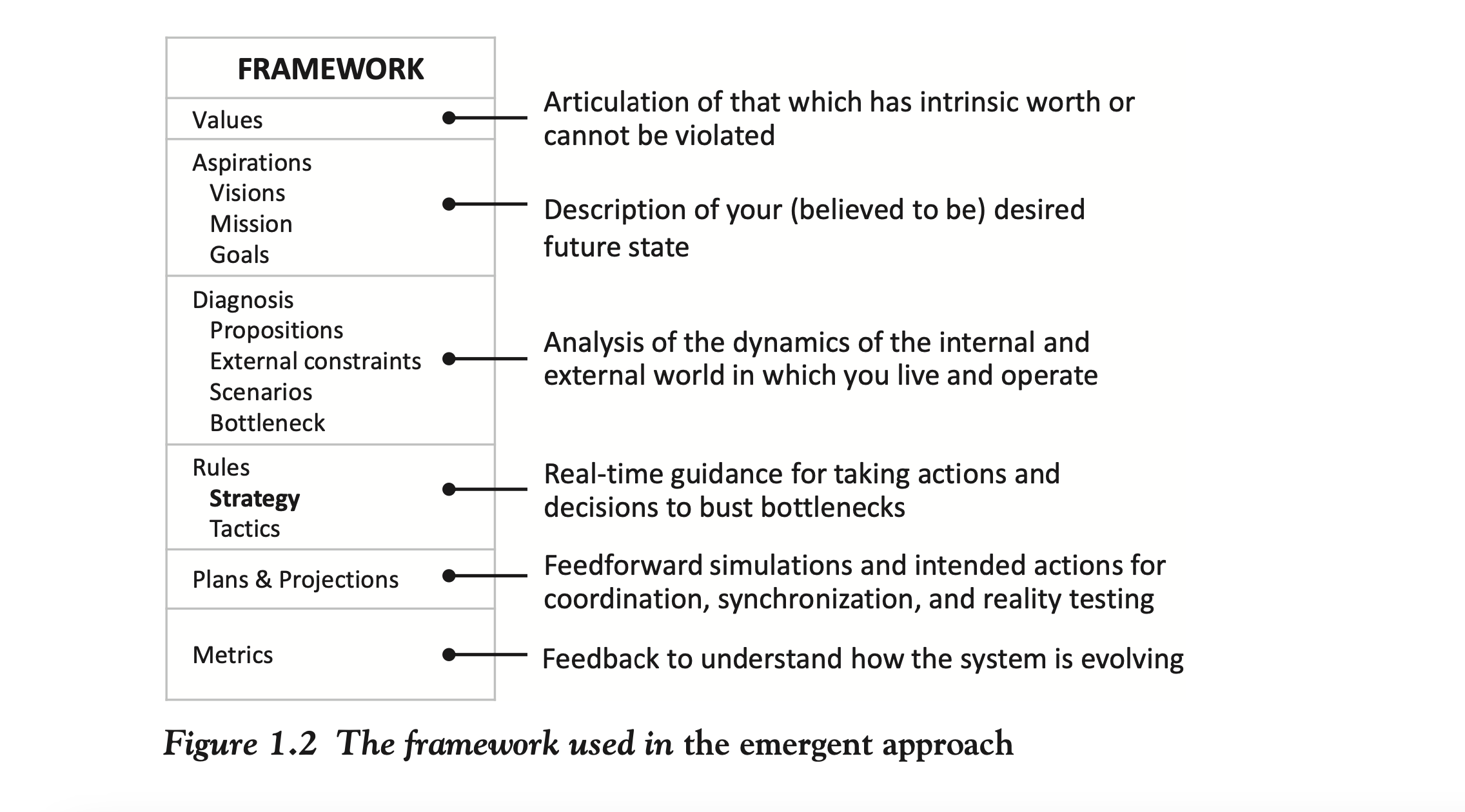
Part II presents a modified practice of traditional approaches that reflects the new theory. It includes the concrete techniques for working in an agile-adaptive versus stepwise linear mode. The focus is on detailed design principles for ensuring the proper functioning of strategy and other framework components. It includes techniques for making diagnosis of propositions, external constraints, scenarios, and most importantly, the bottlenecks to aspirations.
A key takeaway is that strategies must be found from the bottleneck to aspirations, not the aspirations themselves. Hence, the focus throughout the emergent approach on the triad of aspiration, bottleneck, and strategy written as strategy bottleneck aspiration. These three components and the connections between them are the core of what makes a framework unique for a particular endeavour. Everything else—plans, metrics, tactics, and so on—must align with this triad. In a modest endeavour with a light framework development effort, this triad might be one of the few things needed. (Note that the triad is different from Rumelt’s kernel, which he defines as goal [aspiration], central policy [rule], plans.)
Another key point you make is that
“other people’s strategy rules may not sound as momentous or deep as the aspirations they are designed to achieve. Without understanding an individual’s or a group’s reality, with- out walking in their shoes and knowing their bottleneck, their strategy may sound downright trivial.”
Lets next give our audience A Primer on Adaptation and Emergence
“Change and innovation in human endeavours follow adaptive evolutionary mechanisms akin to change and innovations in biological nature.”
I love the serendipity that comes with reading widely and I was recently reading about the survival of the fittest and then came this chapter on adaptive systems. I had started my weekly article on survival of the fittest and this chapter inspired me to complete it and use it as a promotional piece for this episode Peter.
Perhaps you might give us a rendition of:
The Cultural Selection of Early Automobiles
In 1886, Karl Benz and Gottlieb Daimler filed patents for a new species of transportation formed by placing a gasoline engine on a horse carriage— Benz’s was three-wheeled, whereas Daimler’s was four-wheeled. Horseless carriage species attracted investment dollars and were therefore fit to the market because of the potential to free transportation from the limitations of the horse.
Emergence:
To truly understand emergence as it relates to making change and innovating, you highlight A concept that is perhaps the most important for designing frameworks and their strategy—the concept of levels.
Here you use the examples of Ford and Apple.
“innovative organizations like Apple and Ford are extraordinarily disciplined about following principles, but at the same time, enormously intuitive and freethinking. Yet disciplined thought and freedom of thought are seemingly at odds with each other; so much so that business and military strategists offer a solution to the paradox.”
I loved what you said here:
“Discipline at high levels, that is, imposing high-level constraints— demanding a given result, tampering, demanding that results meet plans and predictions—is outcome thinking that leads to paralysis and poor results (planned economies are an extreme example). Freedom at low levels leads to slipshod thoughtless results. Innovative people and organisations are free because of their confidence (conscious or not) in their low-level discipline, not despite it. Deep creativity and intuition are an emergent result of low-level discipline and analytical thinking that leads to internalisation, not direct eureka creative acts. Creativity is a harsh process.”
“If people truly internalise their endeavour and focus on the low-level disciplines and not the high-level outcomes, the resulting creative tension will drive them to generate variations and will enable them to be sensitive to information transmitted to them.” - Another example you give is that of Intel’s CPUs?
