
Looking Is Not Seeing
Too focused counting passes.

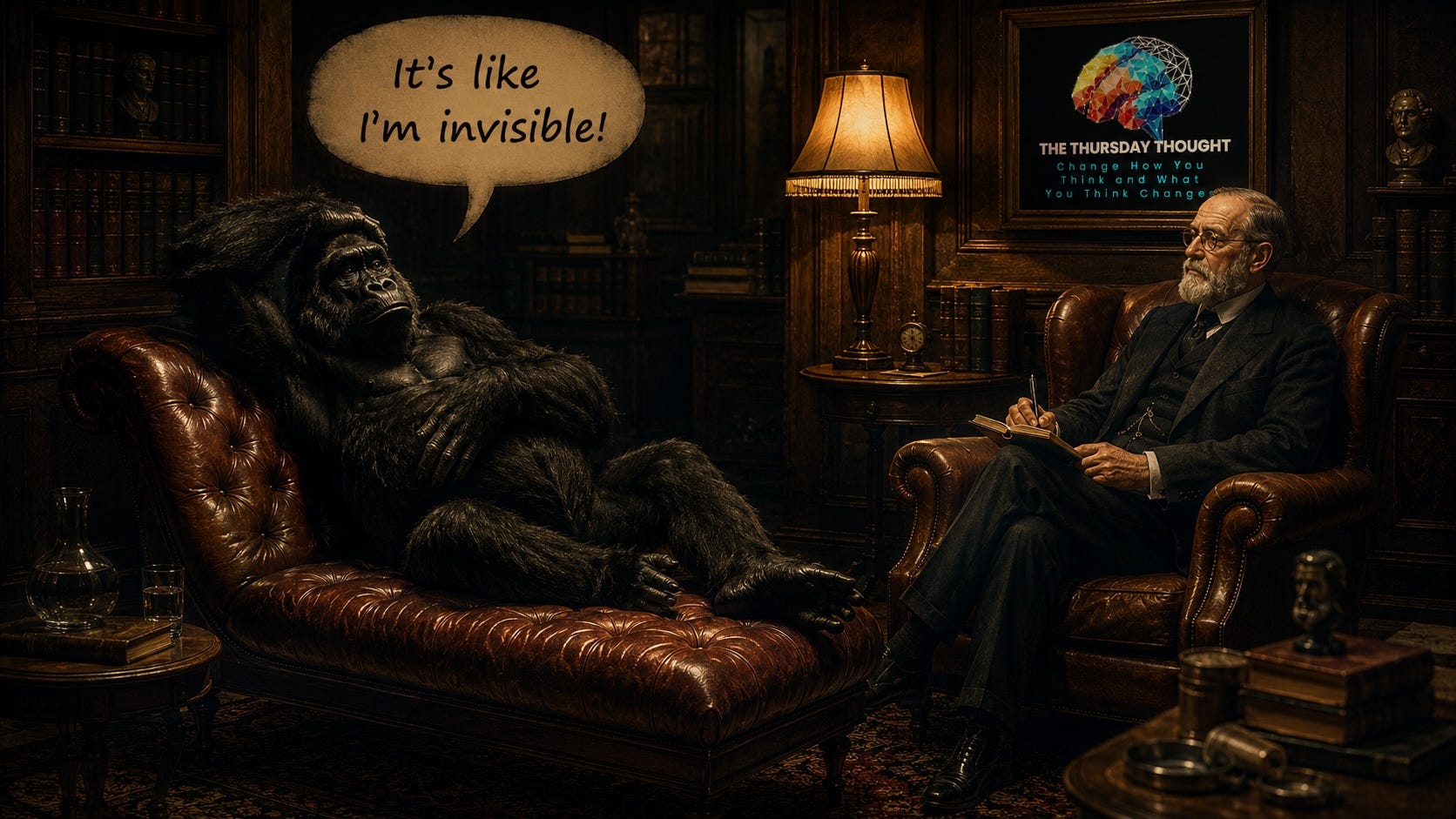
TL;DR: A famous experiment asks viewers to count basketball passes, and roughly half of the viewers fail to notice a person in a gorilla suit strolling through the middle of the game. The lesson drawn is that focus makes us blind. The lesson I want to (ahem) "focus" on is that we always see best what we are looking for, and everything else becomes noise. Steve Jobs's NeXT Cube served the world's first-ever web page and hosted a game that remade an industry. Jobs dismissed both because he was scanning for "serious science". This same pattern shows up wherever a powerful frame encounters a surprising signal. The people who escape the frame are the ones who treat an unexpected use case as data rather than the interference.
“You see, but you do not observe.” -Arthur Conan Doyle, A Scandal in Bohemia
In the most replicated experiment in modern psychology, volunteers watch a short video of two teams passing basketballs and are asked to count the passes made by the players in white. Most do it well. Partway through, a person dressed in a full gorilla suit walks into the middle of the scene, turns to the camera, beats her chest, and walks off. She is a full nine seconds in plain sight. Consistently about half the viewers, concentrating on the white shirts, never see her at all. When the tape is replayed many refuse to believe it is the same video.
“Looking is not the same as seeing.” - Christopher Chabris and Daniel Simons
Christopher Chabris and Daniel Simons wrote The Invisible Gorilla around what this experiment reveals. We tend to trust that we absorb whatever is right in front of us, but we are wrong. Attention is a spotlight, and the spotlight has edges. Whatever falls outside the question we are focusing on falls out of view, however large it is and however hard it thumps its chest.
That is the version of the video most people know, and knowing it is its own kind of trap. In my workshops, I show a version Simons later remade. In this one, two subtle changes are added. The curtain behind the players turns from red to gold and one of the team wearing black leaves the game. Here is the thing. People who had seen the original, now primed and confident and watching hard for the ape, caught the gorilla every time but sailed straight past the curtain and the vanishing player.
Knowing that one unexpected thing was coming did nothing to help them see the next! If anything it gave them something to feel clever about but blinded them to the rest. It is a version of victory disease, a hot hand fallacy of sorts.
If You’re Looking For a Gorilla, You’ll Probably See One
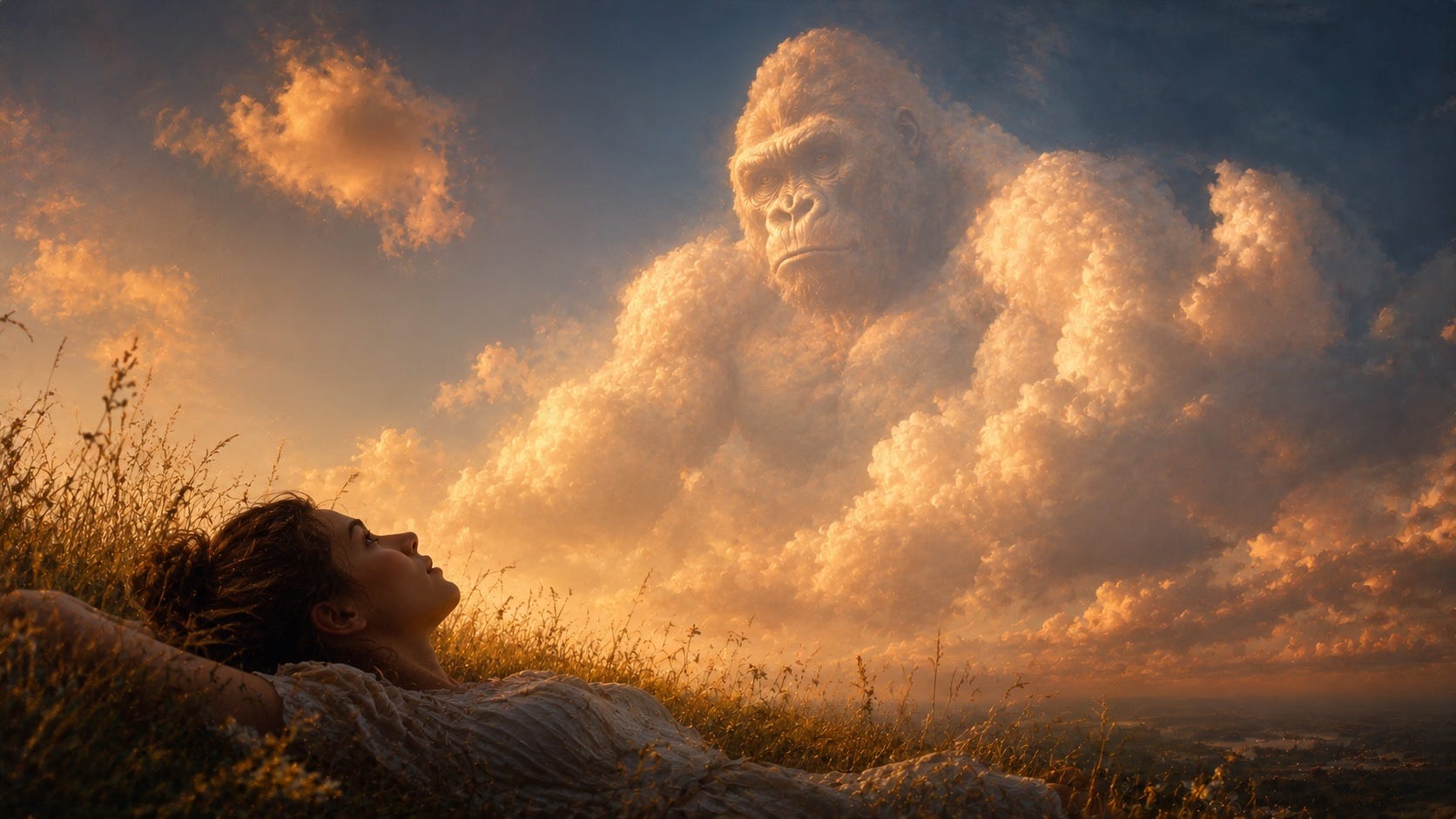
Dr Trafton Drew took the experiment straight into the hospital. He was then a researcher in a visual attention lab at Harvard. He tried the gorilla test on a group of expert radiologists. He pasted a small image of a gorilla, forty-eight times the size of the nodules the doctors were trained to hunt, into a series of CT lung scans. Then he asked twenty-four doctors to do their ordinary work and look for nodules. 83% never saw the gorilla, and eye-tracking revealed that most of those who missed it had looked straight at it. They were expert searchers in their own domain, and an ape was simply not on the list of what they had been trained to find.
The gorilla was never truly invisible, but it was not what anyone had been asked to look for. When you change the instruction (and the rewards), the same image gives up different answers.
This all means the question that decides what you will see is the one you ask before you start looking. But the question is set by your history, your training and what you are rewarded and recognised for. Paradoxically, the most expensive blindness comes from looking too hard, with real discipline and skill, in the wrong direction.
No one illustrates this better than the man we remember as a visionary, but he too was blinded by the questions he was primed to ask.
Two Gorillas Walked Into A (Apple Genius) Bar…
“Focusing is about saying no” - Steve Jobs (WWDC’97)
After Apple forced him out in 1985, Steve Jobs spent more than a decade in the wilderness, and the centre of that exile was a black magnesium cube called the NeXT Computer. Geoffrey Cain tells the story in Steve Jobs in Exile. This was a machine so far ahead of its time that almost nobody could work out what it was for, least of all many of the sales team selling it. Jobs had built it for what he deemed serious work, for scientists and laboratories, for musicians and artists, for higher education and for medical discovery. These were the goals he was focussed on, and that focus made him blind to some clear opportunities.
Jobs had a particular gift for noticing what other people had in front of them and could not see. Early in 1987 an executive at Canon telephoned him and asked him to come to Japan and romp through their laboratories, on the theory that he could spot the magic in their own technology that they had overlooked. Walking through those labs, Jobs fixed on a rewritable optical drive Canon was still developing, a shimmering disc that held more than a hundred times what a floppy could, and decided there and then that it should be the heart of his next computer. He built the cube around it. His reputation rested on exactly this, the knack of looking at another company's components and seeing a future its owners could not see in their own hands.
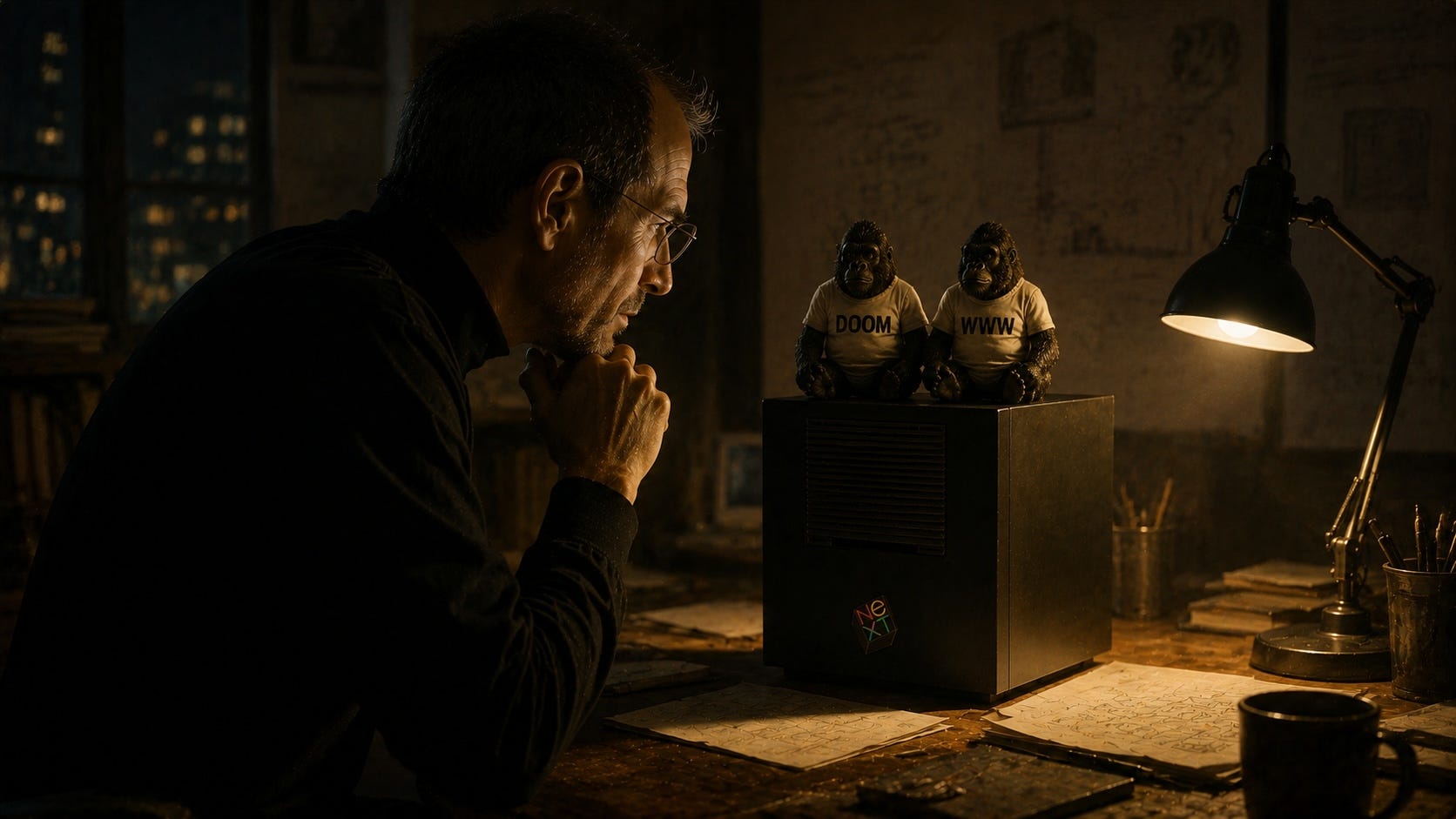
In the autumn of 1990, at the CERN physics laboratory, a visiting software engineer named Tim Berners-Lee took delivery of a NeXT Cube, set it on his desk and used it to write the first web browser and serve the first web page. The World Wide Web was born on a single one of Jobs’s machines.
A few years later 23-year-old programmer John Carmack built Doom on a NeXT cube. Doom was so fast and so violent that it “changed the game” in its industry. Carmack asked NeXT if he might include a line in the game’s opening credits reading “Developed on NeXT computers.” The company said no! Jobs thought games were toys, and NeXT built computers for serious people doing serious work. When Doom became a phenomenon and NeXT scrambled to claim the association, Carmack’s verdict was: “that ship had sailed.”
The same machine, sitting on two different desks, handed the world its defining communications platform and one of its defining cultural products. But the one person you’d think was positioned to see it coming dismissed them both. The man Canon had flown across the world to spot what they had missed could not spot it on his own desk. Why? Because neither matched the search he was running and the lenses he was wearing. He was focussed on counting the white shirts and saying no to anything that didn’t fit that frame. The web and the video game were the gorilla, in plain sight, thumping their chests.
Jobs’s genius was focus, his relentless willingness to say no to a thousand good things in order to do one thing superbly. That same faculty, the disciplined narrowing of attention, is exactly what hides the gorilla. Focus filters out the unexpected by design. Imagine how many products companies have inadvertently filtered out.
Don’t Focus Too (Ahem) Hard
“Instead of passively getting secondary data, actively seek passive data by seeking anomalies.” - Hal Gregersen, in tribute to Clay Christensen
In the early 1990s, Pfizer was developing a compound called sildenafil as a treatment for angina, the chest pain caused by constricted vessels around the heart. The trials were disappointing. By 1993 the company was close to writing the programme off after years of investment.
In a final study in the Welsh town of Merthyr Tydfil, researchers asked volunteers to report any side effects, and the volunteers reported one the chemists had not been looking for at all.
Pfizer was searching the data for a heart drug. The thing that would become one of the best-selling medicines in history was sitting in the column marked “unexpected,” easy to read as a nuisance and discard.
It survived because someone treated the surprising result as the signal rather than the noise, and rebuilt the entire question around it. Viagra reached the market in 1998, found by noticing what they had rather than by looking harder for what they wanted.
Gorillas In Our Midst
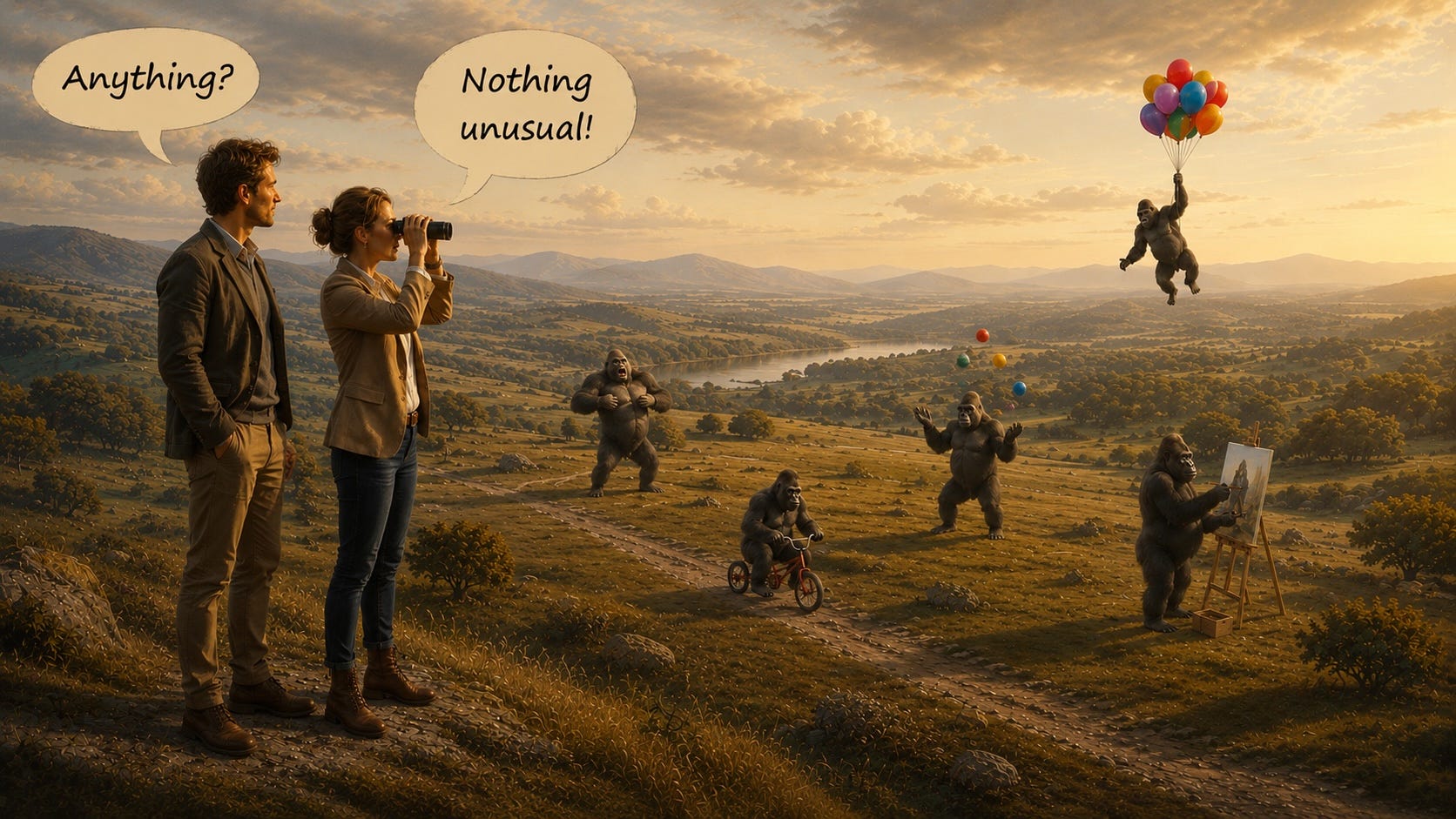
The gorilla experiment flatters us. When you think about it, the gorilla arrives on cue, in the centre of the frame, while we sit primed and watching. True gorillas, real anomalies, are not so obliging. The gorilla does not stroll through a strategy offsite, when the whole company has gathered expressly to look for what it may be missing. Anomalies turn up unannounced, on an ordinary Tuesday, in a part of the business nobody was observing, by somebody who has no way to categorise what they have seen. That is exactly what makes it so hard to catch.
Organisations, in the pursuit of excellence, inadvertently make it even harder to spot unusual threats and opportunities. They reward the executive who shares a target in the board meeting and pursues it without flinching. Researchers at INSEAD, led by Kishore Sengupta, have shown where this leads. They put hundreds of experienced managers through a simulated project that grew and shifted underneath them until the original budget and deadline no longer made any sense.
The researchers call it initial goal bias. People set their targets at the outset, the project changes around them, and instead of recalibrating they drive on toward objectives the world has already overtaken, because revising a goal, in most companies, is read as an admission of failure. This focus can blind us to the gorillas in our midst.
The clearest case sits in the recent history of 3M. In 2000 it installed a chief executive schooled in Six Sigma, the discipline built to reduce variation and stamp out defects. He ran it through the whole company. The numbers improved and the share price recovered, but new products did not. By the time he left for Boeing, the share of revenue coming from recent inventions had plummeted, and his successor spent years prising the research labs back out of the system, on the grounds that invention is a disorderly business and you cannot sit down and schedule yourself “three good ideas on Wednesday and two on Friday.”
The gorilla is not missed only by the person counting. It is screened out by the whole building.
Make The Unexpected Less Unexpected
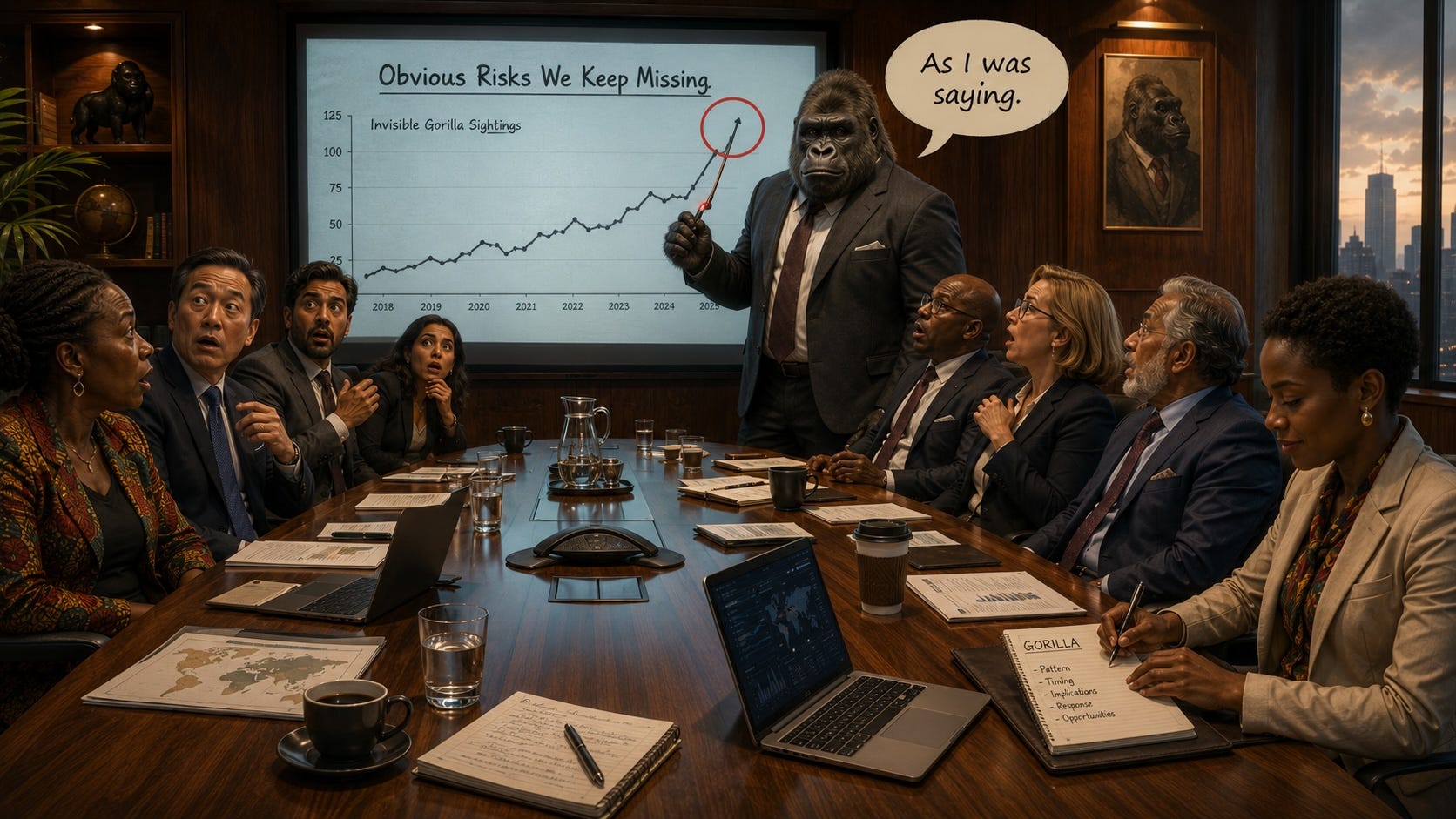
One reliable way to defeat the kind of blindness that accompanies focus is to make the unexpected less unexpected. Walk in expecting the gorilla and you see it every time.
Clayton Christensen turned that into a standing request. Above his office door at Harvard hung a hand-carved wooden sign reading “Anomalies Wanted.” The result that refused to fit his theory was not noise to be tidied away but the most valuable thing on the desk, the surprise that forces a better theory. He went hunting the gorilla on purpose, and hung a sign so that everyone else would bring him theirs.
On this week’s episode of the show, Geoffrey Cain drew the line from the NeXT Cube to the current moment in artificial intelligence. His counsel to the people building the most advanced systems in the world was to watch the edges rather than stare at the roadmap. You might be building an AI to read medical scans, he said, while somewhere a kid in a dorm room is using it for something you never imagined, and if that is happening, the move is to listen, because the revolution may be sitting in the column you have labelled noise.
Berners-Lee and Carmack were that kid, on Jobs’s own machine, and he was not listening. The radiologists were searching for nodules and missed the gorilla. The chemists were looking for a heart drug, and Viagra nearly walked past unseen.
The instruction we prime ourselves with before we start looking does far more work than we credit it. It decides, in advance, which gorillas are salient to us. The most valuable thing the people around us are doing with our work may be precisely the thing we have decided in advance not to look for. It is worth asking, every so often, what we would notice if we changed the question.
This week on The Innovation Show
This piece grew out of this week’s conversation with Geoffrey Cain, author of Steve Jobs in Exile, who came back for the second part of our journey through the decade Jobs spent in the wilderness.
Part one traced the fall; part two follows the long crisis that almost swallowed him. The NeXT Cube sold barely a hundred units a month while Jobs kept inventing the numbers he wished were true, the reality distortion field meeting the one reality it could not bend, and the Pixar gamble quietly turning into the lifeline that brought him back.
Cain reads NeXT as a purpose that took eleven years to surface, and he draws a lesson that what the world needs from you may not match “the vision that you have in your head.” The road back to Apple, when it finally came, turned on a single phone call placed by a junior employee Jobs was barely paying attention to. It is one of the finest business stories I have read in a long time, and the conversation is live now.
"The question is not what you look at, but what you see." — Henry David Thoreau